Showing posts with label VIRTUE. Show all posts

Monday, October 13, 2025

St. Teresa of Avila as a Chess Player


Upcoming on October 15 is the feast of St. Teresa of Avila.  Here is an interesting facet of this great Saint:

One finds in the writings of the saints, and in art, powerful figures of speech depicting God as a lover in ardent pursuit of the human soul. An example is Francis Thompson's poem, The Hound of Heaven.

St. Teresa of Avila, however, in writing about contemplative prayer, reverses the chase. She uses a breath-taking metaphor where the human soul is a chess player seeking to capture Christ the King:

"I hope you do not think I have written too much about this already; for I have only been placing the board, as they say. You have asked me to tell you about the first steps in prayer; although God did not lead me by them, my daughters I know no others, and even now I can hardly have acquired these elementary virtues. But you may be sure that anyone who cannot set out the pieces in a game of chess will never be able to play well, and, if he does not know how to give check, he will not be able to bring about a checkmate. Now you will reprove me for talking about games, as we do not play them in this house and are forbidden to do so. That will show you what kind of a mother God has given you -- she even knows about vanities like this! However, they say that the game is sometimes legitimate. How legitimate it will be for us to play it in this way, and, if we play it frequently, how quickly we shall give checkmate to this Divine King! He will not be able to move out of our check nor will He desire to do so.

"It is the queen which gives the king most trouble in this game and all the other pieces support her. There is no queen who can beat this King as well as humility can; for humility brought Him down from Heaven into the Virgin's womb and with humility we can draw Him into our souls by a single hair. Be sure that He will give most humility to him who has most already and least to him who has least. I cannot understand how humility exists, or can exist, without love, or love without humility, and it is impossible for these two virtues to exist save where there is great detachment from all created things.

"You will ask, my daughters, why I am talking to you about virtues when you have more than enough books to teach you about them and when you want me to tell you only about contemplation. My reply is that, if you had asked me about meditation, I could have talked to you about it, and advised you all to practice it, even if you do not possess the virtues. For this is the first step to be taken towards the acquisition of the virtues and the very life of all Christians depends upon their beginning it. No one, however lost a soul he may be, should neglect so great a blessing if God inspires him to make use of it. All this I have already written elsewhere, and so have many others who know what they are writing about, which I certainly do not: God knows that.

"But contemplation, daughters, is another matter. This is an error which we all make: if a person gets so far as to spend a short time each day in thinking about his sins, as he is bound to do if he is a Christian in anything more than name, people at once call him a great contemplative; and then they expect him to have the rare virtues which a great contemplative is bound to possess; he may even think he has them himself, but he will be quite wrong. In his early stages he did not even know how to set out the chessboard, and thought that, in order to give checkmate, it would be enough to be able to recognize the pieces. But that is impossible, for this King does not allow Himself to be taken except by one who surrenders wholly to Him."
Source:
St. Teresa of Jesus, The Way of Perfection.

Image:
Giovanni di Paolo's, "Madonna of Humility", from the Web Gallery of Art. In the public domain.

Friday, September 26, 2025

The North American Martyrs and the Lake of the Blessed Sacrament


Today, September 26, is the traditional feast day of the North American Martyrs -- Fr. Isaac Jogues, John de Brebeuf, and companions.  The liturgical color is red.  The Mass Propers can be found here.

In 1646, Fr. Isaac Jogues, S.J. (1607-1646) named the body of water depicted in this lovely painting the "Lac du Saint Sacrement" (Lake of the Blessed Sacrament).* In the same year, Fr. Jogues and his companion Jean de Lalande, a lay missionary, were martyred by the Mohawk Indians near what is now Auriesville, New York, about 65 miles from the lake. 

Their martyrdom occurred on October 18, 1646. In 1930, Pope Pius XI canonized Isaac Jogues, along with Jean de Lalande and six other martyred missionaries, now known as the "North American Martyrs". Their feast is celebrated on September 26 in Canada and in the traditional calendar. In the modern calendar, it is celebrated October 19. 

Fr. Jogues was born in Orléans, France on January 10, 1607. He entered the Jesuit novitiate school at Rouen at age 17, and went on to study at the royal college at La Fleche, and then at the College of Clermont at the University of Paris. He celebrated his first Mass on February 10, 1636, and a few months later was on his way to the Jesuit mission in New France on the north American continent:

"In the summer of 1636, at the age of twenty-nine, he embarked for Canada with several of his fellows . . . Drawings of Jogues made at about this time reveal features of unusual refinement; this air of delicacy was, however, deceptive, for beneath it lay heroic powers of physical endurance."
In 1642, some Huron Indian converts, along with missionaries William Couture, Rene Goupil, and Fr. Jogues were attacked by Mohawk warriors. Some of the Hurons escaped. Fr. Jogues could have gotten away too but when he saw that Goupil, a physician, had been captured, he gave himself up. They were taken to the fortress of the Mohawks in what is now east central New York State:
"Fr. Jogues wrote: 'We were made to go up from the shore between two lines of Indians who were armed with clubs, sticks, and knives. I was the last and blows were showered on me. I fell on the ground and thought my end had come, but they lifted me up all streaming with blood and carried me more dead than alive to the platform.' Worse tortures followed. The Iroquois were especially cruel to the Huron converts. At this time and during subsequent torturings Father Jogues suffered the loss of two fingers."
To be more specific, according to Fr. Jogues own description, the Mohawks used their teeth to tear out nearly all of his fingernails and bit off two of his fingers. Goupil was killed, and Fr. Jogues was held as a slave for more than a year:
"'He would sometimes escape. . . and wander in the forest, telling his beads and repeating passages of Scripture. In a remote and lonely spot he cut the bark in the form of a cross from the trunk of a great tree; and here he made his prayers. [He was a] living martyr, half clad in shaggy furs, kneeling in the snow among the icicled rocks and beneath the gloomy pines, bowing in adoration before the emblem of his faith in which was his only consolation and his only hope' . . . The Indians were not without respect for their strange captive, naming him 'the indomitable one.' . . . As opportunity offered, he baptized children he found dying. During the year he baptized some seventy persons . . ."

In Fr. Jogues' letters, he wrote that once he baptized two Indians by using for baptismal water the raindrops that had gathered on some corn stalks given them to chew. He baptized others using water from a stream. Some Protestant Dutchmen helped Fr. Jogues escape his Mohawk captors and paid a sum to the Indians not to pursue him.

On November 5, 1643, Fr. Jogues left by ship from what is now New York City, and towards the end of December reached the coast of Cornwall. From there, he took a coal ship to Brittany, arriving on Christmas Day. Then he traveled on to Rennes where he went to the rector's house. There he astonished the rector since it was commonly believed he had likely been killed.

During an encounter with Fr. Jogues, Anne of Austria (1601-1666) was moved to tears when she saw his wounded hands, which had barely healed from the cruelty of the Indians. The Queen then paid him homage:

"Jogues was received by Anne of Austria, and told his story. At its conclusion, the Queen arose and stooped to kiss the mutilated hands . . ."

Fr. Joques was concerned that the injuries to his hands would make it illicit for him to say Mass. Pope Urban VIII, however, abrogated for him the rule that the Eucharist could only be touched with the thumb and forefinger. In doing this, the Pope used words to the effect that it would not be just to prevent a martyr for Christ from drinking the Blood of Christ.

Fr. Jogues desired to return to North America and was permitted to do so. By June, 1644, he was back in Quebec, and worked successfully for some time, even traveling back and forth to the place where he had formerly been held hostage. In 1646, however, he was again taken captive by the Mohawks, along with the lay missionary Jean de Lalande:

"In the [Mohawk] councils the majority were ready to give the brave Ondessonk [Fr. Jogues] his freedom, but the minority faction, members of the Bear clan, took matters into their own hands. They invited Jogues to pay them a visit, and as he unsuspectingly entered the cabin of the Bear chief, he was brutally tomahawked. The next day Lalande met the same fate, and both bodies were thrown into a nearby ravine. Their heads were cut off and placed on poles facing the trail by which they had come, as if in warning to other Black Robes."
On the site of the martyrdom of Fr. Jogues and Lalande, there is now a shrine:
"Today, near the town of Auriesville, New York, which on the best archeological authority is accepted as the site of Ossernenon, there is a famous Catholic shrine and pilgrimage place. It was dedicated in 1885 to the Martyrs of North America and to their Indian converts. Here pilgrims come to honor the memory of the Jesuits of the seventeenth century who faced death in the wilderness. The eight martyrs—Jogues, Lalande, Brebeuf, Lalemant, Garnier, Daniel, Goupil, and Chabanel . . .".

Source: The quoted material is from "Saint Isaac Jogues, Martyr - 1646", an article in the online library of the Eternal Word Television Network that relies on a Lives of the Saints published by John J. Crawley & Co., Inc., author and year unknown.

Image: Painting by John F. Kensett, from Wikimedia Commons. In the public domain

------------------------------------------------------------ 

*Now more commonly known by its secular name, Lake George, this lake in the Adirondack Mountains of New York State will always be the Lake of the Blessed Sacrament to Catholics.

Monday, August 25, 2025

St. Louis IX, King of France, and the Fleur-de-lis

August 25 is the feast day of St. Louis IX, king of France.  This brings to mind the fleur-de-lis, a stylized image of a lily,* which has come to represent France and especially French monarchs

The French phrase fleur de lis means literally “flower of the lily”. The lily is associated with the Virgin Mary and her purity, and with the Archangel Gabriel, the angel of the Annunciation. The three petals can be seen as standing for the Holy Trinity. During the reign of King Louis IX they also came to represent faith, wisdom, and chivalry. This is not surprising since King Louis (1215-1270) was a monarch endowed with those virtues.

King Louis spent long hours in prayer, singing the Divine Office daily as if he were a monk. He fasted and fed beggars at his table. He did penance and cared for lepers. King Louis led Crusades from 1248-1249 and in 1270. He died near Tunis during the 1270 crusade. At Tradition in Action, Prof. Plinio Correa de Oliveira discusses the attribute of wisdom found in St. Louis IX:

“Our Lady was the Seat of Wisdom and was always seeking to increase her knowledge, love and service of God. “This virtue is demanded of kings, governors, and anyone who exercises some form of power. A king without wisdom loses his people. When he has wisdom, he saves his people, and is the glory of his people. For a man without wisdom, power becomes an instrument of his perdition.
“Hence, we can understand the magnificent eulogy Scriptures made of the wise king. He leads peoples and things to their last end, which is God. This is the ultimate meaning of his kingship.
“What we admire in St. Louis, King of France, is the model of a wise man placed on the throne to govern his kingdom.”

In 1297, less than thirty years after King Louis’ death, Pope Boniface VIII raised him to the altar as a Catholic saint, and we celebrate his feast day today, August 25. 

 Image: Toison D’or le Roi de France [Golden Fleece King of France] from Wikimedia Commons. In the public domain. 

 *There is some controversy over whether the fleur-de-lis represents a lily or a yellow flag iris. Given the importance of the lily in religious iconography, however, the better view is that it represents the lily.

Monday, October 31, 2022

Teaching Loyalty - Part 2

Writing on loyalty and the teaching of loyalty, Fenner continues, 

"Don't discuss family problems with others. Don't criticize your husband, wife, or children to outsiders. Always present them in the very best light possible. Teach your children similar behavior. Explain to them that you are happy to talk things over freely with them at home, but if they repeat what they hear outside, they prove they are unworthy of your trust and it will be withdrawn. Don't repeat your children's confidences to others, no matter how amusing or touching they may be. To do so proves that you are untrustworthy.

 "If an outsider comes to you with a complaint about your child, hear his story fully and weigh it calmly. Do nothing about the matter until you have given your child a chance to tell his side of the story. Do not scold or punish him until you are sure that he was in the wrong. Uphold him and defend him whenever you can, so that he will learn that he can always depend upon getting fair treatment at home. 

"Teach your children to be loyal to each other: not to carry tales, to defend one another against outsiders, to rejoice wholeheartedly in the honors brothers or sisters may attain, to sympathize with troubles. Encourage the boys to cherish and protect their sisters and the girls to look up to their brothers as their champions. Teach the older children to help the younger and the little ones to obey and respect the older ones." 

 Fenner, American Catholic Etiquette (1965), The Newman Press, p. 256.

Saturday, October 29, 2022

Teaching Loyalty - Part 1

According to Kay Toy Fenner, writing in 1965, loyalty is "the keystone of the home. A wife should constantly hold up her husband before her children's eyes as the pattern of all that is good. She should remind them of all he sacrifices for them, all he does to give them protection and pleasure. Her accolade for any childish triumph should be 'Wait until we tell Daddy! How pleased he will be!' A husband's success in business, sports, even in gardening and family repair jobs, should be a matter for admiration and rejoicing. Help your children to understand that everything their father does, he does for them. His only reward is their affection and appreciation. "Husbands, remember that your wife's sole reward for her hard-working days is the comfort and well-being of her family, and the words of praise that she so rarely hears. Let your unfailing courtesy and consideration for her set a constant example to your children. A wife who knows she is admired and treasured by spouse and children can bear hardship, toil, sorrow and privation. . . . Let your family present a united front to the world. Don't repeat to outsiders anything your husband tells you about his business affairs. And remember, 'outsiders' includes your mother, sister, and very best friend! If you want your husband to talk freely about his business pursuits, let him discover that what he says to you will be kept an inviolable confidence. Discuss your sex life only with a doctor or priest. To mention it to anyone else is an unpardonable betrayal of your life partner." Fenner, American Catholic Etiquette (1965), The Newman Press, pp. 255-256.

Tuesday, July 7, 2020

A Man for All Seasons (1988)


This is a review of the made-for-television film A Man for All Seasons (1988) directed by and starring Charlton Heston as St. Thomas More.  It is based on Robert Bolt's play of the same name and is not to be confused with the 1966 version starring Paul Scofield.  The 1988 version is available on DVD and is available from the usual outlets.

I have read several reviews of the 1988 version.  They invariably compare it with the 1966 film, some preferring one and some the other.  One or the other critic fails to realize that Heston was no stranger to the play -- he was More in several off-Broadway and U.K. performances just as Scofield was More on the West End and Broadway.

Personally, I much prefer the 1988 Heston version which, among other things, is more faithful to the script of the play (including the "common man" and the Spanish ambassador characters ).

Some reviewers complain that Heston did not resemble More physically while they imagine that Scofield did.  I am not so sure that is true but even if it were, the inner man is more important than the externals.

In my view, Heston conveyed the persona of More more accurately than Scofield, whose More was aloof and rather condescending.  The real More was humble in the truest sense of the word and thoroughly engaged in everything in his environs -- from the pets he kept (including a monkey) to his natural and acquired children and their spouses, to his own feisty mate Lady Alice, to his father and brother-in-law and many friends, to the citizenry of London whom he served in various legal capacities, to the Church and to the England that cost him his life.

Of central importance is that the Heston version, being more faithful to the play, provides thought-provoking dialogue about More's views of law and conscience upon which one can reflect. 

In his  1999 article in First Things entitled, "Thomas More for Our Season", the late Judge Robert H. Bork opined that Bolt got More right with regard to the saint's understanding of these subjects:
"Again [in Bolt's play, More] says: 'God made the angels to show Him splendor—as He made animals for innocence and plants for their simplicity. But man He made to serve Him wittily, in the tangle of his mind.' Not in the pride and certainty of the individual conscience, but in the tangle of his mind."
A viewer of the film should remember this or he may become confused by the film's several references to More's "private conscience". In fact, More's conscience was not "private" -- it was Catholic.

As Peter Ackroyd suggests in his profoundly moving biography of More, the very word "conscience" implies thinking or knowing "with" (con).  Thinking with the Church is the essence of More's conscience.

In the First Things article, Judge Bork points out that the idea of a individual, private conscience is a Protestant view, not a Catholic one:  In fact, to Judge Bork, "More’s behavior may be seen as submission to external authority, a conscious and difficult denial of self."

While in a sense one's conscience is "private" in that each individual bears responsibility for his moral actions, we have a duty to form our conscience in accordance with the teachings of the Church.

Here it is illuminating to quote from the saint himself -- from his response when he was being coerced to agree with Henry VIII's repugnant policies.

More referred to the church militant elsewhere in Christendom and to the church triumphant in heaven.  Then he asked whether he was bound to conform his conscience "to the Council of one Realm against the general Council of Christendom".  Thus we see that in More's own view his conscience was anything but private; it was formed by and answered to the teachings of the universal Church.  Its locus was eternity.

See the movie and think on these things; they are as relevant now as they were nearly 500 years ago.

Image:   Thomas More and his daughter Meg in his cell in the Tower of London by John Rogers Herbert, 1844.  From Wikimedia Commons.  In the public domain.

Wednesday, April 10, 2013

The Litany of Humility

(by Cardinal Merry del Val)

O Jesus! meek and humble of heart, hear me.
From the desire of being esteemed, Deliver me, Jesus.
From the desire of being loved, . . . (repeat: Deliver me, Jesus)
From the desire of being extolled, . . .
From the desire of being honored, . . .
From the desire of being praised, . . .
From the desire of being preferred to others, . . .
From the desire of being consulted, . . .
From the desire of being approved, . . .
From the fear of being humiliated, . . .
From the fear of being despised, . . .
From the fear of suffering rebukes, . . .
From the fear of being calumniated, . . .
From the fear of being forgotten, . . .
From the fear of being ridiculed, . . .
From the fear of being wronged, . . .
From the fear of being suspected, . . .
That others may be loved more than I, Jesus, grant me the grace to desire it
That others may be esteemed more than I, . . . (repeat:  Jesus, grant me the grace to desire it)
That in the opinion of the world others may increase and I may decrease, . . .
That others may be chosen and I set aside, . . .
That others may be praised and I unnoticed, . . .
That others may be preferred to me in everything, . . .
That others become holier than I, provided that I may become as holy as I should, Jesus, grant me the grace to desire it.

Monday, April 8, 2013

The Virtue of Humility


Four years ago I posted a short piece on the virtue of humility entitled Humility and the Curate's Egg.  Today I thought I'd put up a more expanded post.

Here is the definition of "humility" from the Modern Catholic Dictionary of Fr. John Hardon, S.J.:
HUMILITY. The moral virtue that keeps a person from reaching beyond himself. It is the virtue that restrains the unruly desire for personal greatness and leads people to an orderly love of themselves based on a true appreciation of their position with respect to God and their neighbors. Religious humility recognizes one's total dependence on God; moral humility recognizes one's creaturely equality with others. Yet humility is not only opposed to pride; it is also opposed to immoderate self-abjection, which would fail to recognize God's gifts and use them according to his will. (Etym. Latin humilitas, abasement, humility, from humus, ground.)
And, here is the entire article on the virtue of humility from the Catholic Encyclopedia:


The word humility signifies lowliness or submissiveness an it is derived from the Latin humilitas or, as St. Thomas says, from humus, i.e. the earth which is beneath us. As applied to persons and things it means that which is abject, ignoble, or of poor condition, as we ordinarily say, not worth much. Thus we say that a man is of humble birth or that a house is a humble dwelling. As restricted to persons, humility is understood also in the sense of afflictions or miseries, which may be inflicted by external agents, as when a man humiliates another by causing him pain or suffering. It is in this sense that others may bring about humiliations and subject us to them. Humility in a higher and ethical sense is that by which a man has a modest estimate of his own worth, and submits himself to others. According to this meaning no man can humiliate another, but only himself, and this he can do properly only when aided by Divine grace. We are treating here of humility in this sense, that is, of the virtue of humility.
The virtue of humility may be defined: "A quality by which a person considering his own defects has a lowly opinion of himself and willingly submits himself to God and to others for God's sake." St. Bernard defines it: "A virtue by which a man knowing himself as he truly is, abases himself." These definitions coincide with that given by St. Thomas: "The virtue of humility", he says, "Consists in keeping oneself within one's own bounds, not reaching out to things above one, but submitting to one's superior" (Summa Contra Gent., bk. IV, ch. lv, tr. Rickaby).
To guard against an erroneous idea of humility, it is necessary to explain the manner in which we ought to esteem our own gifts in reference to the gifts of others, if called upon to make a comparison. Humility does not require us to esteem the gifts and graces which God has granted us, in the supernatural order, less than similar gifts and graces which appear in others. No one should esteem less in himself than in others these gifts of God which are to be valued above all things according to the words of St. Paul: "That we may know the things that are given us from God." (1 Corinthians 2:12). Neither does humility require us in our own estimation to think less of the natural gifts we possess than of similar, or of inferior, gifts in our neighbours; otherwise, as St. Thomas teaches, it would behove everyone to consider himself a greater sinner or a greater fool than his neighbour; for the Apostle without any prejudice to humility was able to say: "We by nature are Jews, and not of the Gentiles sinners" (Galatians 2:15). A man, however, may generally esteem some good in his neighbour which he does not himself possess, or acknowledge some defect or evil in himself which he does not perceive in his neighbour, so that, whenever anyone subjects himself out of humility to an equal or to an inferior he does so because he takes that equal or inferior to be his superior in some respect. Thus we may interpret the humble expressions of the saints as true and sincere. Besides, their great love of God caused them to see the malice of their own faults and sins in a clearer light than that which is ordinarily given to persons who are not saints.
The four cardinal virtues are prudence, justice, fortitude, and temperance, and all other moral virtues are annexed to theses either as integral, potential, or subjective parts. Humility is annexed to the virtue of temperance as a potential part, because temperance includes all those virtues that refrain or express the inordinate movements of our desires or appetites. Humility is a repressing or moderating virtue opposed to pride and vainglory or that spirit within us which urges us to great things above our strength and ability, and therefore it is included in temperance just as meekness which represses anger is a part of the same virtue. From what we have here stated it follows that humility is not the first or the greatest of the virtues. The theological virtues have the first place, then the intellectual virtues, as these immediately direct the reason of man to good. Justice is placed in the order of the virtues before humility, and so should obedience be, for it is part of justice. Humility is, however, said to be the foundation of the spiritual edifice, but in a sense inferior to that in which faith is called its foundation. Humility is the first virtue inasmuch as it removes the obstacles to faith — per modum removens prohibens, as St. Thomas says. It removes pride and makes a man subject to and a fit recipient of grace according to the words of St. James: "God resisteth the proud, and giveth his grace to the humble" (James 4:6). Faith is the first and the positive fundamental virtue of all the infused virtues, because it is by it we can take the first step in the supernatural life and in our access to God: "For he that cometh to God, must believe that he is, and is a rewarder to them that seek him" Hebrews 11:6). Humility, inasmuch as it seems to keep the mind and heart submissive to reason and to God, has its own function in connection with faith and all the other virtues, and it may therefore be said to be a universal virtue.
It is therefore a virtue which is necessary for salvation, and as such is enjoined by Our Divine Saviour, especially when He said to His disciples: "Learn of me, because I am meek, and humble of heart: and you shall find rest to your souls" (Matthew 11:29). He also teaches this virtue by the words, "Blessed are ye when they shall revile you, and persecute you and speak all that is evil against you, untruly, for my sake: Be glad and rejoice, for your reward is very great in heaven" (Matthew 5:11-12). From the example of Christ and His Saints we may learn the practice of humility, which St. Thomas explains (Contra Gent., bk, III, 135): "The spontaneous embracing of humiliations is a practice of humility not in any and every case but when it is done for a needful purpose: for humility being a virtue, does nothing indiscreetly. It is then not humility but folly to embrace any and every humiliation: but when virtue calls for a thing to be done it belongs to humility not to shrink from doing it, for instance not to refuse some mean service where charity calls upon you to help your neighbours. . . .Sometimes too, even where our own duty does not require us to embrace humiliations, it is an act of virtue to take them up in order to encourage others by our example more easily to bear what is incumbent on them: for a general will sometimes do the office of a common soldier to encourage the rest. Sometimes again we may make a virtuous use of humiliations as a medicine. Thus if anyone's mind is prone to undue self-exaltation, he may with advantage make a moderate use of humiliations, either self-imposed, or imposed by others, so as to check the elation of his spirit by putting himself on a level with the lowest class of the community in the doing of mean offices."
The Angelic Doctor likewise explains the humility of Christ in the following words: "Humility cannot befit God, who has no superior, but is above all. . . .Though the virtue of humility cannot attach to Christ in His divine nature; it may attach to Him in His human nature and His divinity renders His humility all the more praiseworthy, for the dignity of the person adds to the merit of humility; and there can be no greater dignity to a man than his being God. Hence the highest praise attaches to the humility of the Man God, who to wean men's hearts from worldly glory to the love of divine glory, chose to embrace a death of no ordinary sort, but a death of the deepest ignominy" (Summa Contra Gent., tr. Rickaby, bk. IV. ch. lv; cf. bk. III, ch. cxxxvi). St. Benedict in his rule lays down twelve degrees of humility. St. Anselm, as quoted by St. Thomas, gives seven. These degrees are approved and explained by St. Thomas in his "Summa Theologica" (II-II:161:6). The vices opposed to humility are,
  1. pride: by reason of defect, and
  2. a too great obsequiousness or abjection of oneself, which would be an excess of humility. This might easily be derogatory to a man's office or holy character; or it might serve only to pamper pride in others, by unworthy flattery, which would occasion their sins of tyranny, arbitrariness, and arrogance.
The virtue of humility may not be practised in any external way which would occasion such vices or acts in others.
Sources:
Image:  Bartolo's Madonna of Humility (public domain)
Article:   Devine, A. (1910). Humility. In The Catholic Encyclopedia. New York: Robert Appleton Company. Retrieved April 8, 2013 from New Advent: http://www.newadvent.org/cathen/07543b.htm

Saturday, April 2, 2011

The Quiet American (1958)


The Quiet American (1958) is a black and white film directed and produced by Joseph L. Mankiewicz, who also wrote the screenplay.  It is based on a novel of the same name by Graham Greene and was followed by a remake in 2002.

The motion picture stars Audie Murphy as the American, Michael Redgrave as Thomas Fowler, Giorgia Moll as Phuong, and Claude Dauphin as the French police inspector, Vigot.

A multi-layered story with political intrigue, a detective story, and a romantic triangle, the film opens with the death by drowning of the American, an event that occurs during the Chinese New Year's celebration in Saigon, Vietnam, in 1952.  The story is then told for the most part in flashbacks related by Fowler as Inspector Vigot investigates and questions Fowler and probes into events leading up to the death.

Fowler is a cynical, aging British newspaper correspondent who is ostensibly covering the conflict between the French colonial and Vietnamese imperial forces on the one side, and the Communist rebels on the other. In fact, Fowler works very little and sends his assistant, Dominguez, to the battle zone in his stead. And, although Fowler has a wife back home in England, he lives with Phuong, a beautiful young Vietnamese woman who was formerly a paid "dining and dancing partner" at an establishment called the Rendezvous.

Fowler's assistant, Dominguez, is an enigmatic character whose nationality is not revealed in the film and who is an entirely different person in the book.  Since it eventually comes to light that Dominguez is a Communist, the implication is perhaps that he is a Cuban.

The American (who is nameless in the film, but called Alden Pyle in the novel) is an idealistic young aid worker for a group called Friends for Free Asia.   Influenced by the writings of a political scientist, York Harding, the American is convinced that the answer for Vietnam is the formation of a "Third Force", an alternative to either the preservation of the monarchy/ colonialism or the imposition of Communism.

The American, Fowler, and Phuong become acquainted one evening at the Hotel Continental (a well-known landmark in Saigon in real life), and dine together at the Rendezvous.  While the American and Phuong dance, leaving Fowler to order dinner for the three of them, Phuong's sister, Miss Hei, seizes the opportunity to question Fowler about the American.   Thus begins a campaign by Miss Hei to marry Phuong off to the American, who is more than willing since he has already fallen in love with Phuong.

At the behest of Dominguez, Fowler reluctantly travels north to the battle zone.  To the amazement of the French military, the other correspondents, and Fowler, the American suddenly appears, having driven a Red Cross jeep there from Hanoi for the purpose of telling Fowler that he has fallen in love with Phuong, wants to court her, and wants to be straightforward with Fowler.  The American also brings Fowler a cable forwarded by Dominguez saying that the newspaper has called Fowler home to England.

A couple of weeks later, Fowler returns to Saigon.  Dominguez picks him up at the airport and begins planting suspicions that the American is involved in political machinations. Fowler, however, is more worried about whether the American is engaged in romantic intrigue with Phuong. When Fowler returns to his apartment, Phuong admits she has been seeing the American, but always in the company of Miss Hei.

The American and his dog, Duke, come to visit.  The American proclaims his love for Phuong and his desire to court and marry her.  The encounter upsets Phuong.  She does not actually reject the American but assures Fowler she will remain with him even after Fowler tells her he must return to England.  Then in an effort to compete with the American, Fowler writes to his wife asking for a divorce, knowing in advance that she will not agree because she is a devout believer (high church Anglican.)

Because of the political potentialities of the 25,000-member private Army of the Cao Dai syncretistic religious sect, Fowler and other journalists travel to the sect's "Holy See" at Tay Ninh for the annual Cao Dai festival. There, Fowler sees the American speaking with an associate of General Thé, the former Cao Dai chief of staff, now a renegade from the sect.

After the press conference, the men must return to Saigon before nightfall because of the danger of insurgent attacks at night. The American's automobile has been tampered with and will not start. Fowler offers the American a ride back to Saigon.  Part way, Fowler's automobile, which has been drained of gasoline, runs out near a French watchtower.  The men take refuge in the tower with two young Vietnamese soldiers.  The Communists attack and Fowler is injured attempting to escape.  The American saves Fowler's life by carrying him to safety, then locates a French patrol to take Fowler for medical care.

After a stay in the hospital, Fowler returns to Saigon and hears back from his wife.  He lies to Phuong, telling her that the wife has agreed to a divorce.  Phuong shows the letter to Miss Hei, who knows English.  The truth is revealed and Phuong leaves Fowler for the American.

Meanwhile, Dominguez and a Chinese Communist assassin, Heng, convince Fowler that the American is providing explosives to General Thé as part of a scheme to build the Third Force.  After a deadly bombing in the center of Saigon that is very likely perpetrated by the Communists but blamed on General Thé, Heng proposes that Fowler set up the American for assassination.  Fowler is initially hesitant but after learning that Phuong will soon be leaving for America, he suddenly resolves to cooperate in the assassination plot.

The American is killed and Phuong returns to work at the Rendezvous. Vigot investigates, questions Fowler, and arrests Heng and Dominguez. Fowler's wife belatedly writes that she will agree to the divorce after all and Fowler's paper permits him to remain in Saigon for the time being. Nevertheless, Phuong refuses to reconcile with Fowler who, in the end, is left entirely alone and bereft of any dignity.

Michael Redgrave and Audie Murphy were well cast for their roles. Redgrave skillfully portrays the selfish sarcastic persona of Fowler while at the same time managing to invite a modicum of pity for his character because he reveals the character's underlying psychological fragility.  As for Audie Murphy, he is quite believable as the American, a role for which his personal history fit him very well since he was the most-decorated veteran of World War II.

A lot has been said about the real historical persons and events alluded to in the film, about the war in Vietnam that occurred after the novel, and about the similarities and differences between Greene's novel, Mankiewicz's screenplay, and the 2002 remake. Overall, the 2002 version is not more faithful to the novel as its enthusiasts claim.  In any event, I much prefer Mankiewicz's 1958 film to either the novel or the 2002 film.

What I find most interesting is the film's exploration of how a man's ability to reason and make moral judgments can be undermined by his passions.  In the act of betraying the American, who has saved his life, Fowler reads aloud a passage from Shakespeare's Othello where Iago says, "Though I perchance am vicious in my guess (As, I confess, it is my nature's plague To spy into abuses, and oft my jealousy Shapes faults that are not)". (Act III, Scene 3.)

Nevertheless, Fowler fails to heed the caution suggested by the passage.  He is so unsettled by the impending loss of Phuong that, despite his sophistication and journalistic training, Heng and Dominguez have easily manipulated him into believing that the American is providing General Thé with an explosive named "Diolacton" -- a substance that is fictional in the story as well as in real life -- and Fowler proceeds with the betrayal, then leaves it up to the God he does not believe in to intervene.

Moreover, Fowler's moral culpability is compounded by the fact that he does not truly love Phuong.  After Fowler lies, telling Phuong that his wife is going to permit a divorce, he treats Phuong peremptorily, ordering her about.  And, he tells the American that he does not care about Phuong's "interests".  Rather he just wants her and wants her with him.

One of the many ironies of the story is that while Fowler is loathe to return to England with the monotonous predictability of "the Press Club and the number 78 bus", he has embedded himself into a safe little world with Phuong that is just as narrow, if a bit more exotic.  And, the prospect of that world being torn apart is as shattering to Fowler as the prospect of losing predictable comforts would be to the most timid and banal of the Londoners Fowler disdains.  It is Phuong who dreams of a wider world with her picture books of America and England.

Another irony is that while Fowler sees the American as dangerously naive and foolish, the American sees Fowler as the one who is "truly innocent" because of his lack of self-knowledge and the degree to which his emotions obscure his perceptions.  Before his death, the American  (an Episcopalian) encourages Fowler to examine his conscience and suggests religion as a remedy for his spiritual affliction.  Inspector Vigot (a Roman Catholic) makes the same suggestions after the American's death.  Even when Fowler realizes he has been duped and has pronounced a private death sentence based on insufficient evidence, however, he persists in his atheism.  The end result is that he is left without absolution and without hope.

The film presents religion and morality in a positive light and adultery in a negative light.  There is no nudity, profanity, or vulgarity, and there are no bedroom scenes. I give the 1958 version five roses.

Sunday, July 25, 2010

The Keys of the Kingdom (1944)


The Keys of the Kingdom is a black-and-white motion picture based on a novel of the same name by A.J. Cronin. It is the story of Fr. Francis Chisholm (Gregory Peck), a Scot who becomes a missionary priest serving in China beginning in the late 1800s.

When Francis Chisholm is a young boy, his father is attacked by an anti-Catholic mob. His mother tries to bring her wounded husband home and they both drown while crossing a river in a rainstorm.

After his parents' death, Francis Chisholm lives with distant relatives. With no plans of entering a seminary, he attends a Catholic college, Holywell, where he must work harder than most to comprehend and absorb his studies. He annoys his professors by asking questions about the Faith that they perceive as evidence of doubt. The dean of the college, Fr. Hamish MacNabb (Edmund Gwenn), however, understands and supports him.

Francis Chisholm has a girlfriend back home who fears he will decide to pursue the priesthood. When he is unable to leave the college for an entire year, she becomes despondent, goes downhill, bears a child out of wedlock, and dies. At this point, encouraged by Fr. MacNabb, Francis Chisholm decides perhaps God is calling him to be a priest.

After ordination, Fr. Chisholm fails at his first assignments because of his simplicity, frankness and lack of social skills. Meanwhile, his former dean, Fr. MacNabb, has become his bishop. Bishop McNabb calls Fr. Chisholm in for what the latter expects to be a reprimand. Instead, Bishop MacNabb offers him the challenging assignment of taking over a mission in China.

When Fr. Chisholm reaches the Chinese mission, he discovers that the church building has been destroyed and that the Chinese Catholics have all migrated to a Christian village some distance away.

The Wangs, an insincere Chinese couple claiming to be Catholic, try to manipulate Fr. Chisholm for financial gain. When he sees through their schemes, they turn on him. He opens a street chapel but is rejected and harassed by the Wangs and other locals.

Help comes first through an eager and resourceful young Chinese Catholic, Joseph (Benson Fong), who hears of Fr. Chisholm's arrival, comes in from the Christian village to offer assistance, and becomes a loyal ally. An elderly Chinese woman who knows she will soon die gives Fr. Chisholm and Joseph her tiny granddaughter, Anna, to care for and the three become a community of sorts.

Dr. Willie Tulloch (Thomas Mitchell), a hometown friend, sends Fr. Chisholm a case of medical supplies and instructions. Fr. Chisholm then offers free medical care to the townspeople but again he is rejected. When the son of the mandarin, Mr. Chia, is dying of an infection, however, the mandarin calls in Fr. Chisholm as a last resort.

Fr. Chisholm successfully treats the infection and the son survives. In gratitude, Mr. Chia gives Fr. Chisholm a large parcel of land where he can construct a new church and school. As the Catholic community is rebuilt, Fr. Chisholm requests that teaching sisters be sent from Europe. When they arrive, the patrician Austrian superior, Mother Maria Veronica (beautifully played by the director's wife, Rose Stradner), is put off by Fr. Chisholm's ways and treats him coldly.

During an attack on the town by imperial troops, a heroic act by Fr. Chisholm saves the town but he is left crippled in one leg. Finally, as an elderly man, he is called home to Scotland and given parish assignments where he is again in trouble for his forthrightness. At the conclusion of the film, he is understood by the chancery officials and is a grandfather of sorts to the son of the illegitimate child of his former girlfriend.

There is a great deal of humor in the film, especially in the antics of Joseph. The pace moves along nicely. More importantly, the motion picture presents the Church and the priesthood in a favorable light. Fr. Chisholm is soft spoken, dignified, dedicated, chaste, and courageous.

There is a lovely sequence in Bishop MacNabb's office when Fr. Chisholm kneels to kiss Bishop MacNabb's ring, then the bishop gets out a bottle of Scotch and they have a heart-to-heart talk during which the bishop offers Fr. Chisholm the assignment in China. When Fr. Chisholm accepts, the bishop gives the young Fr. Chisholm a token that symbolizes the bishop's paternal care.

The primary theme of the film is the virtue of humility. One of the ways that theme is beautifully developed is in the relationship between Fr. Chisholm and the aristocratic Mother Maria Veronica. During the story, Mother moves away from the pride she recognizes is her fatal flaw.

The change in Mother begins when the Wangs steal from one of the sisters. Mother has hired the Wangs despite Fr. Chisholm's warning about them. In a sacrificial act accomplished with a grace worthy of her noble breeding, Mother gives the sister in replacement for what was stolen a valuable crucifix that has been in her family for generations. At the same time, Mother's view of Fr. Chisholm begins to change. By the end of the story, they have come to love and respect one another.

No such character development occurs with Fr. Chisholm's hometown friend, Dr. Willie Tulloch. He is the prototype of the "good atheist" who possesses much natural virtue but trusts only in science, not in God. He comes to China to visit Fr. Chisholm and is fatally injured during the attack by the imperialist forces. He persists in his atheism even as he lies dying. His unrepentant death illustrates the limits of the natural virtues, which do not include humility. Fr. Chisholm prays tenderly for Dr. Tulloch, commending him to God's mercy.

During the course of the story, Fr. Chisholm's character as such does not change a great deal either. Rather, by the grace of God, he is placed in a setting where his gifts can best be utilized, and the change that takes place is the development to the fullest of those gifts.

This film can be viewed and enjoyed by persons of all ages. There is no impurity, vulgarity, or excessive violence. On the other hand, the story is at times slightly Modernist in its outlook. The phrase "keys of the kingdom" seems to refer to the virtues of humility and charity rather than the keys of St. Peter.  I give it four and a half roses.

Image:
Keys of the Kingdom video cover, from Wikimedia Commons. Copyrighted material. Fair use claimed.

Friday, June 11, 2010

Manners for Penitents


As she did about manners at Mass, Fenner has some counsel about manners for penitents:
"A penitent should take time properly to examine his conscience and to determine what he has to say to his confessor before entering the confessional. This is for his own soul's good, as it enables him to make a worthy confession. It is also good manners, as it prevents him from staying too long in the confessional, taking up the priest's time and that of waiting penitents.

"A penitent should, while awaiting his turn to go to confession, stand far enough from the confessional so as to be unable to hear anything that may be said in it.

"A penitent should never push his way ahead of others waiting to be heard. This is not only inexcusably bad manners, it is also, considering the place and the purpose, uncharitable and unchristian. But if someone should push his way into the waiting line ahead of you, do not glare and show your displeasure. 'Offer up' this little trial to our Lord as a sacrifice, and be both a good Catholic and a gentleman.

"A penitent should always behave quietly and reverently, remembering Who is present on the altar. School-children going to confession sometimes forget this and giggle and whisper among themselves or tramp about noisily. Parents should caution their children about this.

"In the confessional, the penitent should speak in the lowest audible tone. Should one inadvertently overhear any part of what is said to or by another in Confession, one must never repeat it, and should endeavor to forget it immediately.

"Out of consideration for others, one should avoid choosing the time of one of the great feasts, such as Easter or Christmas, for making a general confession. Since a general confession takes so much longer than an ordinary confession, it imposes a hardship on the busy priest and the many other waiting penitents. This does not mean that a general confession is forbidden at this time, and one may certainly be made on such an occasion if one feels that one's spiritual health requires it. It merely means that it is a courteous act to defer it to a less crowded occasion if one may safely do so."

As for proper dress, Fenner adds, "The proper costume for going to confession is the same as on all other occasions when one is entering the church. When possible, one should be dressed both neatly and formally. . . . Women should buy and keep in their purse the small prayer veils now available, for unplanned visits to the church."
As for the spiritual approach to confession, the thoughts of St. Francis de Sales can be found in the post The Lioness and Her Lord.

Source:
Fenner, Kay Toy; American Catholic Etiquette (Newman Press, Maryland, 1965), pp. 18-19.

Image:
Longhi's "The Confession" (ca. 1750). Oil on canvas. From Web Gallery of Art via Wikimedia Commons. In the public domain.

Sunday, June 6, 2010

Manners at Mass


In her 1965 book, American Catholic Etiquette, Kay Toy Fenner makes some very good points about manners at Mass, all of which relate to consideration for others:
"Proper behavior at Mass and other church services begins outside the church door. If the church has a parking lot, a driver should take care to park properly, to obey all church rules on the subject, and to strive not to inconvenience any other parkers or take up more than his due share of the space. If the church has no parking lot, one should not inconvenience the church's neighbors by parking in front of a driveway or a hydrant. One should never park double or disobey any of the laws of the road.

"Other rules to observe are:

"Come to Mass on time.. . . .

"Always be seated whenever there is space to permit it. Never stand in the back of the church unless you are sure that all seats are filled. . . .

"Move into the pew as far as space permits; leave the entrance to the pew vacant so that others seeking a seat may easily find one. (The exception to this rule is a wedding; those who have the foresight to come early may step into the aisle to let others enter the pew, thus retaining their seat on the aisle, where they can better observe the ceremonies.)

"Those intending to receive Holy Communion should remember to observe the ordinary social amenities as they do so; they should walk up the aisle at a pace that is fast enough to avoid holding others back and slow enough to keep from brushing past others. One should wait until one's turn arrives to approach the rail. If the church has adopted a special method of approaching the Communion rail -- up the main aisle, down the side, etc. all communicants should observe these rules exactly as requested.

"Prepare your contribution before you come to Mass. If your church, like so many others, uses the envelope system for collecting, use the envelope proper to the day; mark on the face of it such information as your church has requested. If you have pledged yourself to contribute a set amount each week, keep your word unless some extraordinary change in your financial situation makes it impossible. . . .

"Mass is not over until the priest has left the altar; the congregation remains until he has done so. When there is an invalid or a baby at home, a man and wife may attend separate Masses. In such a case, one of them may need to leave the church a minute or so before services are ended so that the one waiting at home may be in time for the next Mass. When one has this excuse or some similar valid reason, it is allowable to leave the church before the final prayers have been said. But it is not allowable to leave merely because it is a warm day or in order to escape the crowd."
I would add the following:

Leave your pet at home or get a sitter.  Not only is it irreverent to bring your pet to Mass but it is uncharitable since many individuals are allergic to pet dander.

Turn off your phone.

Leave your water bottle, coffee cup, cookies, pillow, and blanket at home or in your car.  You are assisting at the Holy Sacrifice of the Mass, not attending a sports event.  Christ spent several hours in agony on the Cross.  Surely you can manage to sit on a wooden pew for an hour and a half. You are not a toddler who must drag his bottle and security blanket with him everywhere.

Practice custody of the tongue: Do not talk before, during, or after Mass except in the vestibule or outside the church.

Do not use gestures or facial expressions to communicate with your family members or friends. Keep your focus on the Holy Sacrifice of the Mass.

Practice custody of the eyes: Do not look around at others.

Do not take off your shoes or put your feet on the kneeler.

Do not permit your children to lie down on the pew or wiggle and writhe around, much less run about the church or play with toys.

Absent an emergency, once you are seated, do not leave the pew except to go to Communion.

Go to and return from Communion at the same time as others in your pew. For example, do not come back late by making an excursion to the statute of your favorite saint and then climb over others to return to your seat. Similarly, do not leave the pew late because you feel you must read a large number of prayers before Communion or that you must practice humility by being the last to receive Holy Communion.

If you have an emergency that requires leaving your pew during Mass, quietly let the person next to you know that you need to leave. Give those between you and the exit of the pew a chance to stand or step outside the pew.

When putting down a kneeler, make sure you do not drop it down on someone's foot. Use your hand, not your foot, to bring the kneeler down.

Source:
Fenner, Kay Toy; American Catholic Etiquette (Newman Press; Westminster, Maryland; 1965), pp. 230-232.

Image:
Catedral Nuestra Senora de la Almudena; Madrid, Spain. From Wikimedia Commons. Some rights reserved.

Friday, April 16, 2010

A Necessary Separation (Individual Friendships in the World)


Some writers on spirituality caution against individual friendships. For instance, in Chapter Four of The Way of Perfection, St. Teresa of Avila states, "For the love of the Lord, refrain from making individual friendships, however holy, for even among brothers and sisters such things are apt to be poisonous and I can see no advantage in them . . . " She elaborates on why this is so.

St. Francis de Sales in Introduction to the Devout Life, however, explains that this admonition is meant to apply to religious and not to persons living in the world:
"Do you, my child, love every one with the pure love of charity, but have no friendship save with those whose intercourse is good and true, and the purer the bond which unites you so much higher will your friendship be. If your intercourse is based on science it is praiseworthy, still more if it arises from a participation in goodness, prudence, justice and the like; but if the bond of your mutual liking be charity, devotion and Christian perfection, God knows how very precious a friendship it is! Precious because it comes from God, because it tends to God, because God is the link that binds you, because it will last for ever in Him. Truly it is a blessed thing to love on earth as we hope to love in Heaven, and to begin that friendship here which is to endure for ever there. I am not now speaking of simple charity, a love due to all mankind, but of that spiritual friendship which binds souls together, leading them to share devotions and spiritual interests, so as to have but one mind between them. Such as these may well cry out, 'Behold, how good and joyful a thing it is, brethren, to dwell together in unity!' Even so, for the 'precious ointment' of devotion trickles continually from one heart to the other, so that truly we may say that to such friendship the Lord promises His Blessing and life for evermore. To my mind all other friendship is but as a shadow with respect to this, its links mere fragile glass compared to the golden bond of true devotion. Do you form no other friendships. I say 'form,' because you have no right to cast aside or neglect the natural bonds which draw you to relations, connections, benefactors or neighbors. My rules apply to those you deliberately choose to make. There are some who will tell you that you should avoid all special affection or friendship, as likely to engross the heart, distract the mind, excite jealousy, and what not. But they are confusing things. They have read in the works of saintly and devout writers that individual friendships and special intimacies are a great hindrance in the religious life, and therefore they suppose it to be the same with all the world, which is not at all the case. Whereas in a well-regulated community every one’s aim is true devotion, there is no need for individual intercourse, which might exceed due limits;—in the world those who aim at a devout life require to be united one with another by a holy friendship, which excites, stimulates and encourages them in well-doing. Just as men traversing a plain have no need to hold one another up, as they have who are amid slippery mountain paths, so religious do not need the stay of individual friendships; but those who are living in the world require such for strength and comfort amid the difficulties which beset them. In the world all have not one aim, one mind, and therefore we must take to us congenial friends, nor is there any undue partiality in such attachments, which are but as the separation of good from evil, the sheep from the goats, the bee from the drone—a necessary separation.

"No one can deny that our Dear Lord loved S. John, Lazarus, Martha, Magdalene, with a specially tender friendship, since we are told so in Holy Scripture; and we know that S. Paul dearly loved S. Mark, S. Petronilla, as S. Paul Timothy and Thecla. S. Gregory Nazianzen boasts continually of his friendship with the great S. Basil, of which he says: 'It seemed as though with two bodies we had but one soul, and if we may not believe those who say that all things are in all else, at least one must affirm that we were two in one, and one in two —the only object that both had being to grow in holiness, and to mold our present life to our future hopes, thereby forsaking this mortal world before our death.' And S. Augustine says that S. Ambrose loved S. Monica by reason of her many virtues, and that she in return loved him as an Angel of God.

"What need to affirm so unquestionable a fact! S. Jerome, S. Augustine, S. Gregory, S. Bernard, and all the most notable servants of God, have had special friendships, which in nowise hindered their perfection. S. Paul, in describing evil men, says that they were 'without natural affection,' i.e. without friendship. And S. Thomas, in common with other philosophers, acknowledges that friendship is a virtue, and he certainly means individual friendships, because he says that we cannot bestow perfect friendship on many persons. So we see that the highest grace does not lie in being without friendships, but in having none which are not good, holy and true."

As should be obvious from the foregoing, St. Francis de Sales is not advocating the formation or preservation of friendships with romantic or sexual overtones (sometimes euphemistically referred to as "special friendships"). And, St. Teresa condemns such friendships even more vigorously than individual friendships in general.

Source:
St. Francis de Sales, Introduction to the Devout Life, Part III, Chapter XIX.

Image:
Vermeer's "Christ in the House of Martha and Mary", from Wikimedia Commons. In the public domain.

Thursday, February 18, 2010

Innocence and Penitence


These early days of Lent invite reflection on the theme of innocence and penitence. Last year, there was a good sermon available online that spoke to subject. Unfortunately, the sermon is no longer accessible. There, Father affirmed that innocence is, of course, best. He described penitence as next best, however, and said it is very pleasing to God.

Father went on to talk about how the Blessed Mother is the model of innocence and the Magdalene is the model of penitence. He pointed out that in Mel Gibson's film, The Passion of the Christ, the Blessed Mother and St. Mary Magdalene are shown staying together in Jerusalem during Christ's Passion and that this could be a metaphor for the closeness of true penitence to innocence. He said that St. Mary Magdalene was the only saint in the entire canon given the title of "Penitent", which suggests her perfection as a model for all penitents.

In his Modern Catholic Dictionary, Fr. John A. Hardon, S.J., defines the two concepts as follows:
"INNOCENCE. Freedom from sin or moral guilt. Applied to Adam and Eve before the Fall, to those who have just been baptized, and to persons who never lost the state of grace because they never committed a grave sin. (Etym. Latin innocens: in-, not + nocere, to harm, hurt.)

"PENITENCE. The state of being repentant for having sinned. It is therefore a disposition of soul, arising from a realization of one's sinfulness and includes the willingness to expiate the wrongdoing."
Of course, no one can approach the innocence of the Blessed Mother who was born without the stain of original sin (the Immaculate Conception). Several saints, however, are believed to have preserved their baptismal innocence. These include: St. Dominic de Savio, St. John of the Cross, St. Bernadette of Lourdes, St. Pio, and St. Gemma Galgani.

Most of us, unfortunately, lose our baptismal innocence then regain it for a time through the sacrament of confession, as we struggle to become more like St. Mary Magdalene in penitence. There is a good post at Vultus Christi that speaks of "Innocence Restored".

The image above of St. Mary Magdalene (left) and the Blessed Mother gazing at the Crucified Christ after he was taken down from the Cross and prior to his burial might be useful for meditating on the closeness of true Penitence to Innocence.

May all the readers of this blog make a good Lent!

Image:
Detail from Perugino's "Companto sul Cristo Morto", from Wikimedia Commons. The painting is in the public domain. For compilation copyright free licensing information click on this link.

Thursday, February 11, 2010

The Initiative of Greeting & the Benedicite-Dominus Greeting


Those making the transition to Traditional Catholicism soon perceive its richness and learn that nothing is meaningless or escapes integration into the Catholic worldview. Every gesture and movement of the traditional Latin Mass is so replete with symbolism that its study must be inexhaustible, and the same applies to the liturgical year. Awareness of the constant presence of Heaven and the Communion of Saints challenges and enlarges one's perspective. Even the petty annoyances of daily existence are given meaning as opportunities to unite oneself to the sufferings of Christ and to grow in virtue. A blessed child it is who is reared with the fullness of the true Faith.

One small facet of the wealth of Catholicism can be found in a section on greeting in Dr. Marian Horvat's book, The Catholic Manual of Civility.

First, Dr. Horvat explains:
"Crossing the path of a person of authority or higher dignity, it is the younger or less important person who should offer the first greeting."
Then she goes on to say:
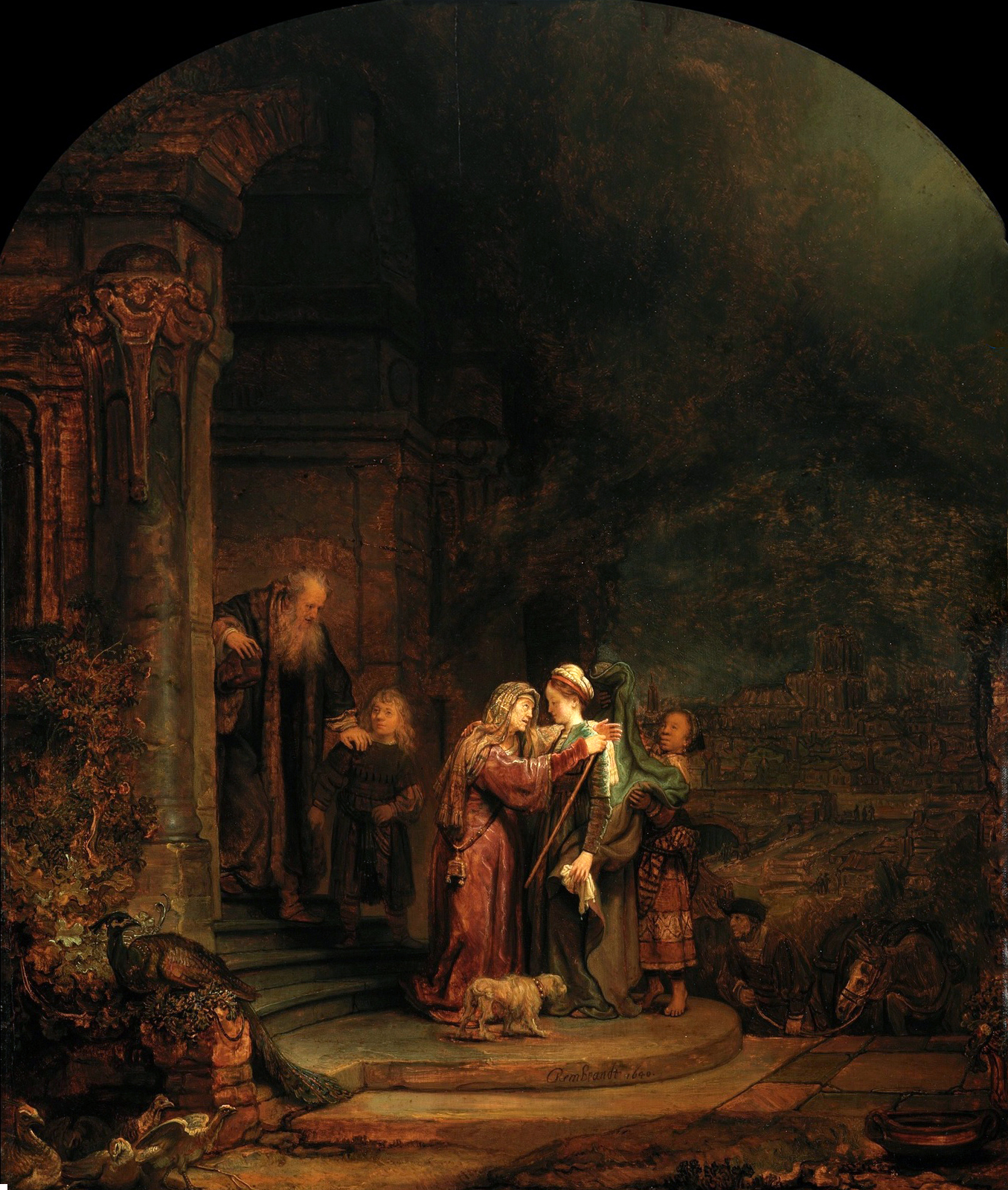
"When Our Lady learned that Elizabeth was with child, she did not delay to make plans to travel from Nazareth to Hebron to congratulate her cousin for this high favor from God. At the meeting, the one who initiated the greeting was the Blessed Virgin, who was younger in age even though she was superior to Elizabeth in dignity: And Mary entered into the house of Zachary and saluted Elizabeth. And it came to pass that when Elizabeth heard the salutation of Mary, the infant leaped in her womb. And Elizabeth was filled with the Holy Ghost. (Lk 1:40-41)

"Her words were accompanied by a prodigy of grace: the sanctification of John the Baptist, who leaped with joy in his mother's womb. It is to commemorate and imitate the humility of Mary in this greeting that the laws of certain religious congregations impose on the superiors the initiative of greeting."
That is, because of her Immaculate Conception and Divine Maternity, the Blessed Virgin was superior in dignity to St. Elizabeth. Nevertheless, virtuous woman that she was, she humbly initiated the greeting of her older relative, Elizabeth.

The practice of superiors initiating the greeting as described by Dr. Horvat is depicted in the film The Nun's Story. More than once in the film, the mother superior greets Sr. Luke with "Benedicite", to which Sr. Luke responds, "Dominus".

I have read that the benedicite-dominus greeting originated with the Benedictines.  That is, the younger religious would say to the older religious or to the superior, "Benedicite" (Bless me) and the latter would reply "Dominus te benedicat" (May the Lord bless you).   But in The Nun's Story the greeting is shortened and it is the superior who initiates the greeting, asking to be blessed.

With this traditional practice in mind, every "Good morning" or "Good evening" can become a reminder to reflect in passing on the virtue of humility.

Source:
Horvat, Marian Therese, Catholic Manual of Civility (Tradition in Action, Los Angeles, 2008), p. 100.

Image:
Rembrant's "Visitation", from Wikimedia Commons. In the public domain.

Friday, January 29, 2010

Near the Crib of Christ


In the traditional calendar, today January 29, is the feast day of St. Francis de Sales (1567- 1622), Bishop of Geneva and the author of Introduction to the Devout Life, Treatise on the Love of God, and other works.*

This wonderful saint was born to aristocratic parents at Thorens, in the Duchy of Savoy (France). He was consecrated the Bishop of Geneva in 1602. At that time, the seat of the Bishop of Geneva was in Annecy in Savoy as the Calvinists controlled Geneva.

St. Francis de Sales fought the heresy of Calvinism and is said to have brought 72,000 heretics to the true Faith. Under his spiritual guidance, St. Jane Frances de Chantal founded the Order of the Visitation. He was beatified in 1661, canonized in 1665, and declared a Doctor of the Church in 1877.

In The Liturgical Year, Dom Gueranger said, "The angelic bishop Francis of Sales has a right to a distinguished position near the Crib of Jesus, on account of the sweetness of his virtues, the childlike simplicity of his heart, and the humility and tenderness of his love."

An touching example of St. Francis de Sales' "simplicity of heart" is found in his statement about St. Mary Magdalene in Introduction to the Devout Life (Part III, Chapter XXIX): "Simon the leper called Magdalene a sinner, because she had once lived a life of sin; but he lied, for she was a sinner no longer, but rather a very saintly penitent, and so our Lord Himself undertook her defense."

The saint died in Lyons. His body was brought to Annecy while his heart was kept at Lyons. He is buried at the Visitation Convent of Annecy. At the time of the French Revolution, the Visitation nuns took his heart from Lyons to Venice. According to the Catholic Encyclopedia, "A great number of wonderful favors have been obtained at his tomb in the Visitation Convent of Annecy."

Image:
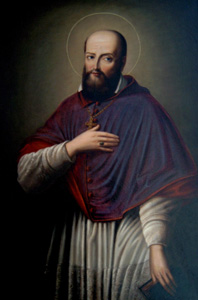
St. Francis de Sales from Wikimedia Commons. In the public domain.
-----
*In the Novus Ordo calendar, his feast day was celebrated January 24.

Friday, January 22, 2010

The Lioness and Her Lord


In Introduction to the Devout Life, St. Francis de Sales uses a compelling metaphor about a lioness to describe the soul's need for the sacrament of Confession:
"Our Savior has bequeathed the Sacrament of Penitence and Confession to His Church, in order that therein we may be cleansed from all our sins, however and whenever we may have been soiled thereby. Therefore, my child, never allow your heart to abide heavy with sin, seeing that there is so sure and safe a remedy at hand. If the lioness has been in the neighborhood of other beasts she hastens to wash away their scent, lest it should be displeasing to her lord; and so the soul which has ever so little consented to sin, ought to abhor itself and make haste to seek purification, out of respect to His Divine Gaze Who beholds it always. Why should we die a spiritual death when there is a sovereign remedy available?

"Make your confession humbly and devoutly every week, and always, if you can, before communicating, even although your conscience is not burdened with mortal sin; for in confession you do not only receive absolution for your venial sins, but you also receive great strength to help you in avoiding them henceforth, clearer light to discover your failings, and abundant grace to make up whatever loss you have incurred through those faults. You exercise the graces of humility, obedience, simplicity and love, and by this one act of confession you practice more virtue than in any other.

"Be sure always to entertain a hearty sorrow for the sins you confess, however small they are; and also a steadfast resolution to correct them in the future. Some people go on confessing venial sins out of mere habit, and conventionally, without making any effort to correct them, thereby losing a great deal of spiritual good. Supposing that you confess having said something untrue, although without evil consequences, or some careless words, or excessive amusement;—repent, and make a firm resolution of amendment: it is a mere abuse to confess any sin whatever, be it mortal or venial, without intending to put it altogether away, that being the express object of confession.

"Beware of unmeaning self-accusations, made out of a mere routine, such as, 'I have not loved God as much as I ought; I have not prayed with as much devotion as I ought; I have not loved my neighbor as I ought; I have not received the Sacraments with sufficient reverence;' and the like. Such things as these are altogether useless in setting the state of your conscience before your Confessor, inasmuch as all the Saints in Paradise and all men living would say the same. But examine closely what special reason you have for accusing yourself thus, and when you have discovered it, accuse yourself simply and plainly of your fault. For instance, when confessing that you have not loved your neighbor as you ought, it may be that what you mean is that having seen some one in great want whom you could have succored, you have failed to do so. Well then, accuse yourself of that special omission: say, “Having come across a person in need, I did not help him as I might have done,” either through negligence, or hardness, or indifference, according as the case may be. So again, do not accuse yourself of not having prayed to God with sufficient devotion; but if you have given way to voluntary distractions, or if you have neglected the proper circumstances of devout prayer whether place, time, or attitude—say so plainly, just as it is, and do not deal in generalities, which, so to say, blow neither hot nor cold.

"Again, do not be satisfied with mentioning the bare fact of your venial sins, but accuse yourself of the motive cause which led to them. For instance, do not be content with saying that you told an untruth which injured no one; but say whether it was out of vanity, in order to win praise or avoid blame, out of heedlessness, or from obstinacy. If you have exceeded in society, say whether it was from the love of talking, or gambling for the sake of money, and so on. Say whether you continued long to commit the fault in question, as the importance of a fault depends greatly upon its continuance: e.g., there is a wide difference between a passing act of vanity which is over in a quarter of an hour, and one which fills the heart for one or more days. So you must mention the fact, the motive and the duration of your faults. It is true that we are not bound to be so precise in confessing venial sins, or even, technically speaking, to confess them at all; but all who aim at purifying their souls in order to attain a really devout life, will be careful to show all their spiritual maladies, however slight, to their spiritual physician, in order to be healed.

"Do not spare yourself in telling whatever is necessary to explain the nature of your fault, as, for instance, the reason why you lost your temper, or why you encouraged another in wrong-doing. Thus, some one whom I dislike says a chance word in joke, I take it ill, and put myself in a passion. If one I like had said a stronger thing I should not have taken it amiss; so in confession, I ought to say that I lost my temper with a person, not because of the words spoken so much as because I disliked the speaker; and if in order to explain yourself clearly it is necessary to particularize the words, it is well to do so; because accusing one’s self thus simply one discovers not merely one’s actual sins, but one’s bad habits, inclinations and ways, and the other roots of sin, by which means one’s spiritual Father acquires a fuller knowledge of the heart he is dealing with, and knows better what remedies to apply. But you must always avoid exposing any one who has borne any part in your sin as far as possible. Keep watch over a variety of sins, which are apt to spring up and flourish, often insensibly, in the conscience, so that you may confess them and put them away . . .

"Do not lightly change your Confessor, but having chosen him, be regular in giving account of your conscience to him at the appointed seasons, telling him your faults simply and frankly, and from time to time—say every month or every two months, show him the general state of your inclinations, although there be nothing wrong in them; as, for instance, whether you are depressed and anxious, or cheerful, desirous of advancement, or money, and the like."
Source:
St. Francis de Sales, Introduction to the Devout Life, Part II, Chapter XIX, "On Confession".

Image:
Antoine-Louis Barye's, "Lions near their Den" from Web Gallery of Art. In the public domain.