Showing posts with label CLERGY. Show all posts

Friday, September 26, 2025

The North American Martyrs and the Lake of the Blessed Sacrament


Today, September 26, is the traditional feast day of the North American Martyrs -- Fr. Isaac Jogues, John de Brebeuf, and companions.  The liturgical color is red.  The Mass Propers can be found here.

In 1646, Fr. Isaac Jogues, S.J. (1607-1646) named the body of water depicted in this lovely painting the "Lac du Saint Sacrement" (Lake of the Blessed Sacrament).* In the same year, Fr. Jogues and his companion Jean de Lalande, a lay missionary, were martyred by the Mohawk Indians near what is now Auriesville, New York, about 65 miles from the lake. 

Their martyrdom occurred on October 18, 1646. In 1930, Pope Pius XI canonized Isaac Jogues, along with Jean de Lalande and six other martyred missionaries, now known as the "North American Martyrs". Their feast is celebrated on September 26 in Canada and in the traditional calendar. In the modern calendar, it is celebrated October 19. 

Fr. Jogues was born in Orléans, France on January 10, 1607. He entered the Jesuit novitiate school at Rouen at age 17, and went on to study at the royal college at La Fleche, and then at the College of Clermont at the University of Paris. He celebrated his first Mass on February 10, 1636, and a few months later was on his way to the Jesuit mission in New France on the north American continent:

"In the summer of 1636, at the age of twenty-nine, he embarked for Canada with several of his fellows . . . Drawings of Jogues made at about this time reveal features of unusual refinement; this air of delicacy was, however, deceptive, for beneath it lay heroic powers of physical endurance."
In 1642, some Huron Indian converts, along with missionaries William Couture, Rene Goupil, and Fr. Jogues were attacked by Mohawk warriors. Some of the Hurons escaped. Fr. Jogues could have gotten away too but when he saw that Goupil, a physician, had been captured, he gave himself up. They were taken to the fortress of the Mohawks in what is now east central New York State:
"Fr. Jogues wrote: 'We were made to go up from the shore between two lines of Indians who were armed with clubs, sticks, and knives. I was the last and blows were showered on me. I fell on the ground and thought my end had come, but they lifted me up all streaming with blood and carried me more dead than alive to the platform.' Worse tortures followed. The Iroquois were especially cruel to the Huron converts. At this time and during subsequent torturings Father Jogues suffered the loss of two fingers."
To be more specific, according to Fr. Jogues own description, the Mohawks used their teeth to tear out nearly all of his fingernails and bit off two of his fingers. Goupil was killed, and Fr. Jogues was held as a slave for more than a year:
"'He would sometimes escape. . . and wander in the forest, telling his beads and repeating passages of Scripture. In a remote and lonely spot he cut the bark in the form of a cross from the trunk of a great tree; and here he made his prayers. [He was a] living martyr, half clad in shaggy furs, kneeling in the snow among the icicled rocks and beneath the gloomy pines, bowing in adoration before the emblem of his faith in which was his only consolation and his only hope' . . . The Indians were not without respect for their strange captive, naming him 'the indomitable one.' . . . As opportunity offered, he baptized children he found dying. During the year he baptized some seventy persons . . ."

In Fr. Jogues' letters, he wrote that once he baptized two Indians by using for baptismal water the raindrops that had gathered on some corn stalks given them to chew. He baptized others using water from a stream. Some Protestant Dutchmen helped Fr. Jogues escape his Mohawk captors and paid a sum to the Indians not to pursue him.

On November 5, 1643, Fr. Jogues left by ship from what is now New York City, and towards the end of December reached the coast of Cornwall. From there, he took a coal ship to Brittany, arriving on Christmas Day. Then he traveled on to Rennes where he went to the rector's house. There he astonished the rector since it was commonly believed he had likely been killed.

During an encounter with Fr. Jogues, Anne of Austria (1601-1666) was moved to tears when she saw his wounded hands, which had barely healed from the cruelty of the Indians. The Queen then paid him homage:

"Jogues was received by Anne of Austria, and told his story. At its conclusion, the Queen arose and stooped to kiss the mutilated hands . . ."

Fr. Joques was concerned that the injuries to his hands would make it illicit for him to say Mass. Pope Urban VIII, however, abrogated for him the rule that the Eucharist could only be touched with the thumb and forefinger. In doing this, the Pope used words to the effect that it would not be just to prevent a martyr for Christ from drinking the Blood of Christ.

Fr. Jogues desired to return to North America and was permitted to do so. By June, 1644, he was back in Quebec, and worked successfully for some time, even traveling back and forth to the place where he had formerly been held hostage. In 1646, however, he was again taken captive by the Mohawks, along with the lay missionary Jean de Lalande:

"In the [Mohawk] councils the majority were ready to give the brave Ondessonk [Fr. Jogues] his freedom, but the minority faction, members of the Bear clan, took matters into their own hands. They invited Jogues to pay them a visit, and as he unsuspectingly entered the cabin of the Bear chief, he was brutally tomahawked. The next day Lalande met the same fate, and both bodies were thrown into a nearby ravine. Their heads were cut off and placed on poles facing the trail by which they had come, as if in warning to other Black Robes."
On the site of the martyrdom of Fr. Jogues and Lalande, there is now a shrine:
"Today, near the town of Auriesville, New York, which on the best archeological authority is accepted as the site of Ossernenon, there is a famous Catholic shrine and pilgrimage place. It was dedicated in 1885 to the Martyrs of North America and to their Indian converts. Here pilgrims come to honor the memory of the Jesuits of the seventeenth century who faced death in the wilderness. The eight martyrs—Jogues, Lalande, Brebeuf, Lalemant, Garnier, Daniel, Goupil, and Chabanel . . .".

Source: The quoted material is from "Saint Isaac Jogues, Martyr - 1646", an article in the online library of the Eternal Word Television Network that relies on a Lives of the Saints published by John J. Crawley & Co., Inc., author and year unknown.

Image: Painting by John F. Kensett, from Wikimedia Commons. In the public domain

------------------------------------------------------------ 

*Now more commonly known by its secular name, Lake George, this lake in the Adirondack Mountains of New York State will always be the Lake of the Blessed Sacrament to Catholics.

Sunday, October 1, 2023

St. John Bosco and His Gray Dog


St. John Bosco (1815-1888) was a priest born near Castelnuovo in the archdiocese of Turin, Italy. He was ordained a priest in 1846, beatified in 1929, and canonized in 1934. His feast day is January 31.

The saint founded an oratory named after St. Francis de Sales, and eventually a men's order called The Society of St. Francis de Sales (Salesians). With the help of Sr. Mary Dominic Mazzarello, he also founded a women's order called the Institute of the Daughters of Mary Auxiliatrix (Mary, Help of Christians).

His principal work was the development of an educational system based on "reason, religion, and kindness". He conducted workshops for tradesmen and manual laborers, schools for young workers, and for men preparing for the priesthood. He was opposed by anti-clerical forces and subjected to violent attacks by them.

A remarkable aspect of St. John Bosco's life is the protection he received from a mysterious dog. Here is an account from the Fish Eaters website:
"When returning home one night through a bad and dangerous part of the town, he saw a magnificent dog of huge size following him. At first he was frightened but quickly came to see that the dog was friendly. The animal walked by his side and accompanied him to the door of his house and then went away. This happened five, six or eight times. He called the dog Grigio [Gray]
. . . .

"Hastening home by himself, some time after the first appearance of the dog, two shots were fired at him by an assassin from behind a tree. Both shots missed their mark, but his assailant then rushed at and grappled with him. At that moment, Grigio appeared and sank his teeth into the flesh of the would-be murderer, who fled away shrieking with pain.

"On a second occasion, two men lay in wait for him and threw a sack over his head. This time it seemed all was over with him, but Grigio unexpectedly came to his rescue and jumped at one of the ruffians, seizing him by the throat. The other fled in terror. Don Bosco had then to liberate the first from the fangs of Grigio, who still held him by the throat.

"A third time, no less than twelve hired assassins, armed with clubs, lay in ambush, into which Don Bosco walked unawares. Again, escape seemed impossible, but once more Grigio bounded into the midst of the group, and his fierce look and savage growl proved enough. The men made off as quickly as they could."

You can read the rest of the story at Fish Eaters
Source for biographical material:
Aumann, Jordan, O.P. and Lodi, Enzo; Saints of the Roman Calendar (Alba House, New York, 1992); pp. 35-36.

Image:
St. John Bosco from Wikimedia Commons. In the public domain.

Saturday, March 12, 2011

Satan Never Sleeps (1962)


Satan Never Sleeps is a 1962 motion picture directed by Leo McCarey and based on a novel by Protestant China missionary daughter, Pearl S. Buck. It was not a commercial success and it is easy to understand why.

The script uses the same light humor and silly interaction between a grumpy older priest (Fr. Bovard played by Clifton Webb) and a bumbling younger cleric (Fr. O'Banion played by William Holden) that worked in McCarey's Going My Way.  In this film, however, those antics fall flat because McCarey transposes them onto two incredibly serious and grim subjects -- the brutality with which the Chinese communists persecuted the Chinese Christians and Christian missionaries in the late 1940s, and the marriage of a woman to her rapist so that the child born of the rape will know his father.

A positive aspect of the film is that it accurately depicts such tragic events as the communists trashing the interior of the church, tearing down the crucifix, putting up Chairman Mao's picture where the crucifix used to be, and using the church for communist indoctrination sessions.  That is just what the Reds did many places in real life.

Another positive thing is that for the most part both priests are courageous.  And, Fr. O'Banion maintains his chastity despite being ardently pursued by a physically attractive and romantically aggressive young woman (Siu Lan played by France Nuyen).

Unfortunately, the film is riddled with such nonsense as a scene where Siu Lan smiles and waves flirtatiously at Fr. O'Banion while he is kneeling during a Mass offered by Fr. Bovard right after the priests discover that most of the Chinese Catholics have deserted the church in fear of the communists, who have just taken over the town.

Later, when a local ex-altar boy turned communist (Ho San played by Weaver Lee) rapes Siu Lan, it is such a jarring departure from all the silliness that it is as if one is watching a different movie.  And, when Ho San converts back to Catholicism after losing status with the communists for being too individualistic, one questions the sincerity of his re-conversion.

As if that transition did not make impossible demands on the viewer, Ho San then marries Siu Lan and when their baby is baptized by Fr. O'Banion, the silliness is reintroduced.  I found it offensive that this supposedly "happy ending" is treated with the same fluffiness as the conclusion of any television sit-com from the 1970s.

I would really like to see a new version of this film with the screenplay re-written as a drama that does justice to the very serious questions presented.  It might be quite good.  As it is, the only value the movie has is its accurate portrayal of Chinese communist atrocities and the heroic resistance of the Chinese Catholics, who tear down Mao's picture and try to raise the Cross again. For that I give the film three roses.

Sunday, March 6, 2011

The Fugitive (1947) - based on The Power and the Glory by Graham Greene


The Fugitive (1947) is a lovely, luminous film directed by John Ford.  It is a must for traditional Catholics.  I am surprised that it has not been given more recognition.  Henry Fonda, playing the priest who is the main character, understood his role and never failed to maintain a priestly dignity even when exhausted, threatened, or subjected to humiliations.

The story is of the events in the last days of the life of a priest in a Central American country where religion has been outlawed and the clergy martyred.  The unnamed priest played by Fonda is the one cleric who has not yet been captured and assassinated.

In the Graham Greene book on which the film is based (The Power and the Glory, originally published in the United States as The Labyrinthine Ways), the country was Mexico and the priest was an alcoholic.  Although in the film the priest is merely traumatized (as if "shell-shocked") --  and not an alcoholic -- that does not necessarily detract from the power of the story.

The important thing is that the priesthood is larger than the priest -- something he acknowledges toward the end of the film.  And, while being pursued by the police, he faithfully fulfills his priestly duties by administering the sacraments when sought by believers, sometimes reluctantly and with conflict and always at the risk of his own personal safety.

The motion picture was made in Mexico and the cinematography by Mexican Gabriel Figueroa is unfailingly beautiful. Many of the actors are also Mexican.  Dolores del Rio is exquisite as the Indian woman who protects the priest.  A wonderful sequence takes place in the cantina where she works.  At the beginning of that sequence, a man sings a mournful ballad that reaches deeply into the soul, and before the end of the sequence, when Dolores del Rio dances on the bar to distract the police who are looking for the priest, one feels keenly the sacrifice she is making despite her apparent gaiety.

Another wonderful part of the film is when the fleeing priest is called upon to administer the last rites to a woman from a middle class family. Afterward, the men of the family prevail on the priest to say Mass -- something he cannot do because there is no wine to consecrate:  wine has been outlawed along with religion and apparently as part of the effort to suppress the sacraments.

Pedro Armendariz skillfully portrays the atheistic lieutenant who pursues the priest with determination but not without a level of inner conflict. An interesting supporting character is the "trickster" figure, an informant who sets up the priest for his ultimate capture.  Another is The Gringo, an American gangster, who helps the priest but refuses the sacraments as he lays dying.  These two roles are well developed and well played by J. Carrol Naish and Ward Bond respectively.

This is a film I will watch again and again.  My only complaint is that The Criterion Collection has not offered it as a DVD, because the celluloid could use the technical improvements that Criterion accomplishes so marvelously.  I purchased it second-hand in a Region 2 DVD from Spain in English with Spanish subtitles, changed the region code on my computer, and watched it that way. There is no language option for English without subtitles but I found the Spanish subtitles helpful because the audio is not as distinct as it might be.

Needless to say, I give the film five roses.

Sunday, July 25, 2010

The Keys of the Kingdom (1944)


The Keys of the Kingdom is a black-and-white motion picture based on a novel of the same name by A.J. Cronin. It is the story of Fr. Francis Chisholm (Gregory Peck), a Scot who becomes a missionary priest serving in China beginning in the late 1800s.

When Francis Chisholm is a young boy, his father is attacked by an anti-Catholic mob. His mother tries to bring her wounded husband home and they both drown while crossing a river in a rainstorm.

After his parents' death, Francis Chisholm lives with distant relatives. With no plans of entering a seminary, he attends a Catholic college, Holywell, where he must work harder than most to comprehend and absorb his studies. He annoys his professors by asking questions about the Faith that they perceive as evidence of doubt. The dean of the college, Fr. Hamish MacNabb (Edmund Gwenn), however, understands and supports him.

Francis Chisholm has a girlfriend back home who fears he will decide to pursue the priesthood. When he is unable to leave the college for an entire year, she becomes despondent, goes downhill, bears a child out of wedlock, and dies. At this point, encouraged by Fr. MacNabb, Francis Chisholm decides perhaps God is calling him to be a priest.

After ordination, Fr. Chisholm fails at his first assignments because of his simplicity, frankness and lack of social skills. Meanwhile, his former dean, Fr. MacNabb, has become his bishop. Bishop McNabb calls Fr. Chisholm in for what the latter expects to be a reprimand. Instead, Bishop MacNabb offers him the challenging assignment of taking over a mission in China.

When Fr. Chisholm reaches the Chinese mission, he discovers that the church building has been destroyed and that the Chinese Catholics have all migrated to a Christian village some distance away.

The Wangs, an insincere Chinese couple claiming to be Catholic, try to manipulate Fr. Chisholm for financial gain. When he sees through their schemes, they turn on him. He opens a street chapel but is rejected and harassed by the Wangs and other locals.

Help comes first through an eager and resourceful young Chinese Catholic, Joseph (Benson Fong), who hears of Fr. Chisholm's arrival, comes in from the Christian village to offer assistance, and becomes a loyal ally. An elderly Chinese woman who knows she will soon die gives Fr. Chisholm and Joseph her tiny granddaughter, Anna, to care for and the three become a community of sorts.

Dr. Willie Tulloch (Thomas Mitchell), a hometown friend, sends Fr. Chisholm a case of medical supplies and instructions. Fr. Chisholm then offers free medical care to the townspeople but again he is rejected. When the son of the mandarin, Mr. Chia, is dying of an infection, however, the mandarin calls in Fr. Chisholm as a last resort.

Fr. Chisholm successfully treats the infection and the son survives. In gratitude, Mr. Chia gives Fr. Chisholm a large parcel of land where he can construct a new church and school. As the Catholic community is rebuilt, Fr. Chisholm requests that teaching sisters be sent from Europe. When they arrive, the patrician Austrian superior, Mother Maria Veronica (beautifully played by the director's wife, Rose Stradner), is put off by Fr. Chisholm's ways and treats him coldly.

During an attack on the town by imperial troops, a heroic act by Fr. Chisholm saves the town but he is left crippled in one leg. Finally, as an elderly man, he is called home to Scotland and given parish assignments where he is again in trouble for his forthrightness. At the conclusion of the film, he is understood by the chancery officials and is a grandfather of sorts to the son of the illegitimate child of his former girlfriend.

There is a great deal of humor in the film, especially in the antics of Joseph. The pace moves along nicely. More importantly, the motion picture presents the Church and the priesthood in a favorable light. Fr. Chisholm is soft spoken, dignified, dedicated, chaste, and courageous.

There is a lovely sequence in Bishop MacNabb's office when Fr. Chisholm kneels to kiss Bishop MacNabb's ring, then the bishop gets out a bottle of Scotch and they have a heart-to-heart talk during which the bishop offers Fr. Chisholm the assignment in China. When Fr. Chisholm accepts, the bishop gives the young Fr. Chisholm a token that symbolizes the bishop's paternal care.

The primary theme of the film is the virtue of humility. One of the ways that theme is beautifully developed is in the relationship between Fr. Chisholm and the aristocratic Mother Maria Veronica. During the story, Mother moves away from the pride she recognizes is her fatal flaw.

The change in Mother begins when the Wangs steal from one of the sisters. Mother has hired the Wangs despite Fr. Chisholm's warning about them. In a sacrificial act accomplished with a grace worthy of her noble breeding, Mother gives the sister in replacement for what was stolen a valuable crucifix that has been in her family for generations. At the same time, Mother's view of Fr. Chisholm begins to change. By the end of the story, they have come to love and respect one another.

No such character development occurs with Fr. Chisholm's hometown friend, Dr. Willie Tulloch. He is the prototype of the "good atheist" who possesses much natural virtue but trusts only in science, not in God. He comes to China to visit Fr. Chisholm and is fatally injured during the attack by the imperialist forces. He persists in his atheism even as he lies dying. His unrepentant death illustrates the limits of the natural virtues, which do not include humility. Fr. Chisholm prays tenderly for Dr. Tulloch, commending him to God's mercy.

During the course of the story, Fr. Chisholm's character as such does not change a great deal either. Rather, by the grace of God, he is placed in a setting where his gifts can best be utilized, and the change that takes place is the development to the fullest of those gifts.

This film can be viewed and enjoyed by persons of all ages. There is no impurity, vulgarity, or excessive violence. On the other hand, the story is at times slightly Modernist in its outlook. The phrase "keys of the kingdom" seems to refer to the virtues of humility and charity rather than the keys of St. Peter.  I give it four and a half roses.

Image:
Keys of the Kingdom video cover, from Wikimedia Commons. Copyrighted material. Fair use claimed.

Wednesday, March 31, 2010

Journal d'un curé de campagne (1951)


This is the second part of a two-part review of the novel and film Journal d'un curé de campagne (Diary of a Country Priest) by Georges Bernanos and Robert Bresson respectively. An earlier post focused on the 1936 book by Bernanos. Today's is about the 1951 film, written and directed by Robert Bresson.

Bresson was born on September 25, 1901, at Bromont-Lamothe, Puy-de-Dôme, and educated at Lycée Lakanal à Sceaux, Paris. Before becoming a film director he was a painter and a photographer. During World War II, he spent over a year in a prisoner-of-war camp. He made thirteen feature-length films, often using non-professional or little known actors. In 1967, he made a film based on another Bernanos book, Mouchette. Bresson died in Paris on December 18, 1999.

Bresson's script for the film is for the most part quite faithful to the book. We see the Curé's diary and hear its contents in the voice of the Curé. Dialogue is used so sparingly that the viewer finds himself in a unique psychological and aesthetic space between a silent film and a talking picture. Music is used rarely but to good effect.

Bresson's fidelity to the novel makes visually and audibly present the various events in the Curé's Way of the Cross that were described in the review of Bernanos' book. As in the book, however, the allusions are subtle and one's recognition of them is belated. Critic André Bazin was aware of this aspect of the work and described it as liturgical.

The visuals are without exception exquisitely beautiful, in black and white. Much attention is given to the facial expressions, body language, and movements of Claude Laydu, who plays the Curé.

The casting and performances of the Count, the Countess, Louise, Chantal, Seraphita, and even the very minor characters are without exception flawless, as are the settings and camera work. A psychiatrist in real life plays the priest of Torcy and he is entirely believable. Marie-Monique Arkell is perfect as the Countess. The encounter between the Curé and the Countess where he fights for her soul could not be better.

It is said that Bresson would only cast a faithful Catholic for the role of the Curé and that Laydu lived with a group of young priests prior to the filming so he could acquire their gestures and movements. It is also said that Laydu fasted during the filming in order to lend credibility to the role. One wonders whether he also fasted for spiritual reasons. Toward the end of the film Laydu merges so completely with the character that one beholds a man who is as entirely spiritualized as one can be in this life. And, one feels a deep gratitude to Laydu for the sacrifices he made for the sake of the film.

In various reviews and the commentary, much nonsense is said about Bernanos, Bresson, and the film. Particularly annoying are those claiming that Bresson was a Jansenist heretic or an agnostic. Significantly, none of these claims include a direct statement by Bresson that he was either. A single viewing of the film is enough to conclude that no agnostic would -- or could -- have made it. Moreover, Bresson closes the film with the actual words used by Bernanos, "Tout est grâce". ("All is grace"). No Jansenist would make such a statement.

The Jansenist view of grace is a withholding one, where God metes out grace to a chosen few, overwhelming their free will, while leaving the vast majority of humanity unredeemed. The phrase "all is grace" was taken by Bernanos from the lips of the Little Flower, Thérèse of Lisieux (1873-1897). One of the major reasons the Little Flower was so beloved during the first half of the twentieth century was that her view of grace was such an effective antidote for the residual poison of Jansenism. By adopting her language, Bernanos and Bresson clearly rejected the heresy of Jansenism. Those who claim otherwise should be ignored.

In her 1937 translation of Bernanos' book into English, Pamela Morris exchanged "Grace is everywhere" for "Tout est grâce". To say "grace is everywhere" is in keeping with scripture. "And where sin abounded, grace did more abound." (Romans 5:20.) Thus, Morris' statement is theologically correct. It is not, however, a direct translation of what Bernanos, Bresson, or the Little Flower actually said.

What did Bernanos, Bresson, and Little Flower mean by "all is grace"? Speaking concretely, all is definitely not grace. To make this statement with the intention that it be taken literally would be to promote the heresy of pantheism, i.e. "everything is God", but surely this was not the intention.

The key to Bernanos' and Bresson's use of the phrase is found in a striking moment in the film. The Curé is struggling for the Countess' soul. She refers to her husband's infidelities and then says, "There's nothing in my past to blush about." To this, the Curé replies, "Blessed is sin if it teaches us shame." (This is very similar to the portrayal of the event in the novel.) The Curé does not mean that the sin itself is a blessing but rather that it is a blessing if the sin brings about humility and repentance in the individual. This too is consistent with scripture, "And we know that to them that love God, all things work together unto good, to such as, according to his purpose, are called to be saints." (Romans 8:28.)

Thus, Bernanos' and Bresson's use of "tout est grâce" should be understood to mean that grace is always and everywhere present -- along with what is not grace -- even though one might not be able to perceive it. With spiritual maturation, one's vision is enlarged to see the presence of grace in past and current circumstances -- a vision that becomes complete for the Curé as he lies dying.

With each repeated viewing of Bresson's exquisite film, one's experience of it deepens; its meaning -- and Bernanos' -- penetrates farther into one's interiority. The riches of this beautiful story and film are seemingly inexhaustible.

The film is available in DVD format from the Criterion Collection and can be purchased from the usual outlets.

Image:
Ruysdael's "After the Rain", from the Web Gallery of Art. In the public domain.

Thursday, March 11, 2010

A Prayer for Priests


Part II of the review of the book by Georges Bernanos and the film by Robert Bresson, Diary of a Country Priest, will not be posted this week as promised because another week or two will be required to complete it.

This prayer for priests, however, is very much in keeping with the theme of the book and film and therefore is offered here for both prayer and reflection:
A Prayer for Priests
"IN THE NAME OF THE MOST HOLY TRINITY, Father, Son and Holy Ghost, we beseech Thee, O Christ, Eternal High Priest, that Thou keep hidden within the Wound in Thy Heart Thy priests whom Thou hast ordained to Thy Eternal Priesthood.
"Preserve them, protect them as the dispenser of the mysteries of God and keep them faithful in their mission as Thy expiatory victims for the sins of men. Together with Thee, O Christ, are they continually offered on Thy Altar on High in the sight of the Father, a propitiation of love rising as incense from men to God. Ever increase in Thy faithful priest-victims Thy power to draw all hearts into Thy Own that Thou mayest perfect Thy work of grace among the sons of God, whose inheritance is the Kingdom of Heaven.
"Have pity, O Christ, on those of Thy priviliged ones who have strayed from Thy Heart and torn open the Wound in Thy Side by their infidelity to Thee. Release upon them the torrents of Thy love and compassion, drowning their souls in Thy ocean of mercy that they may not escape. Draw them back into the fullness of the Life and the Light that is of God. Amen."
"IMPRIMATUR
+Henry J. O'Brien, D.D., Archbishop of Hartford, April 1, 1959".
Source:
Prayers for Priests, compiled by John Bosco Books, 1994. All rights reserved.

Image:
El Greco's "Agony in the Garden". From Web Gallery of Art. In the public domain.

Friday, March 5, 2010

Diary of a Country Priest (Bernanos, 1936)


This is the first part of a two-part review of the 1936 novel by Georges Bernanos, Journal d'un curé de campagne (Diary of a Country Priest), and the 1951 film by director Robert Bresson based on the novel.

Bernanos was awarded the Grand Prix du Roman de L'Académie française for the novel, while Bresson's film won eight international awards, including the Grand Prize at the Venice International Film Festival.

Bernanos and Bresson were both French Catholics. Bresson also made a film based on another book by Bernanos, Mouchette. This post will focus on the book Diary of a Country Priest. Part II will focus on Bresson's film of the same name. Perhaps sometime in the future there will also be a post on Mouchette.

Bernanos was born on February 20, 1888, in Paris, and spent most of his childhood and youth in Fressin, a small village in the Pas de Calais region. He was educated by Jesuits at Vaugirard College, where one of his classmates was the future General, Charles de Gaulle. Bernanos attended the Institut Catholique and the University of Paris, where he received licentiates in law and letters. One source says that he attended two minor seminaries before going on to the Sorbonne and that he had at one time thought to become a priest.

Bernanos was a cavalryman in World War I, was wounded and received the Croix de Guerre. He married in 1917. His wife, of the family Du Lys D'Arc, was a direct descendant of the brother of St. Joan of Arc. The couple had three boys and three girls. The family lived in various places, including South America from 1938 to 1945, much of that time on a remote farm in Brazil. Between 1926 and 1945, sixteen of his books were published. Bernanos died at Neuilly sur-Seine on July 5, 1948.

The reader is not told the year in which the events of the novel Diary of a Country Priest take place. There is a reference to a motorbike, however, and other commentary that seems to set the novel at about the same time it was written. The main character and narrator is a nameless Catholic priest, about 30 years of age, who keeps a journal as a way of gathering his thoughts.

The young Curé comes from a poor background but entered the seminary at the age of 12 and was a gifted student. Now he has been assigned to the village of Ambricourt as the parish priest. According to his Dean, Ambricourt is a "double parish". It includes many smaller villages and he has many homes to visit. Although he goes about his work with dedication and sincerity, the villagers reject him. The only person who attends weekday Mass is Louise, the governess in the home of a Count who lives in a nearby château.

The Curé is sickly and becomes increasingly so as time goes on. He finds his stomach can only tolerate sugared wine, dry bread, and sometimes baked apples or potatoes. For this and other minor things, he is suspected, ridiculed and condemned. He thinks he might have tuberculosis but puts off going to Lille to see a specialist for diagnosis.

Occasionally, the Curé visits an older priest in the nearby village of Torcy who apparently was one of his teachers in the seminary. The older priest has a bleak view of the degree to which humans have been wounded by Adam's sin. His worldview is perhaps more Lutheran than Catholic. In fact his first name is Martin and he prays regularly for Martin Luther. One should not confuse the voice of the priest of Torcy with the voice of Bernanos or the voice of the Church. Still, there is sometimes humor in the ramblings of this older priest that is enjoyable to read.

The priest of Torcy seems to have a genuine affection for the Curé but calls him a "ragamuffin" and berates him about his demeanor and his diet. He even complains about the cloak the Curé wears, which was given to him by an aunt, because he thinks it makes the Curé look like "a romantic German poet." Their conversations are mostly one-sided harangues by the priest of Torcy. Early on, the priest advises the Curé, "A true priest is never loved, get that into your head. . . . Try first to be respected and obeyed. What the Church needs is discipline."

Lacking social skills, the Curé often alienates one or the other villager while always intending to do good. At the same time, on occasion he has an uncanny ability to read souls and exercise his priestly authority in a manner that can only be explained by God acting through him.

A sexually precocious village girl name Seraphita torments the Curé. She is the star pupil in his catechism class. He believes she is longing for her First Holy Communion. When he asks her about it, however, she says, "It'll come soon enough." He replies, "But you understand me though, you listen so well." To this, she responds, "It's 'cause you've got such lovely eyes."

In his sickness and isolation the Curé longs for, and finds himself incapable of, deep prayer. "I know, of course, that the wish to pray is a prayer in itself, that God can ask no more than that of us. But this was no duty which I discharged. At that moment I needed prayer as much as I needed air to draw my breath or oxygen to fill my blood. . . . A void was behind me. And in front a wall, a wall of darkness."

The Count's daughter, Chantal, believes that the governess, Louise, is the Count's mistress, which may be true. She hates Louise, hates the Countess for tolerating Louise's presence, and is angry with her father. Both Louise and Chantal seek the Curé's help and he is thus drawn in to the struggles at the château. The Curé receives an ominous note warning him to leave the village that he later discovers was likely written by the governess, Louise.

One of the most dramatic parts of the book begins when the Curé approaches the Countess about Chantal, who he fears is suicidal. It emerges that the Countess has been alienated from God for years because her only son died when he was just eighteen months old. What ensues is an encounter where the Curé fights for the Countess's soul in a struggle so fierce it almost resembles an exorcism. The result is that the Countess is reconciled to God. The next day she writes to the Curé telling him of the peace she has found. That night she has an angina attack and dies. Chantal then lies about what occurred between her mother and the Curé, and he is blamed for the Countess' death.

Toward the end of the novel, the Curé sometimes feels healthier while in fact his condition is rapidly worsening. On his way back from a round of home visits, he hemorrhages and collapses, vomiting blood. Seraphita discovers and helps him. She thinks perhaps someone at one of the homes he has visited poisoned him. "Someone's been poppin' ash in your glass -- they think it's funny, a kind o' joke." Later, however, Seraphita describes the incident to Chantal who uses the information to further discredit the Curé.

Among the minor characters is a general practitioner, Dr. Delbende, who lost his faith in medical school, spends his life in doing works of mercy, but in the end commits suicide because of financial problems. Another is Louis Dufréty, a priest who took a leave for health reasons and ended up cohabitating with a former charwoman from the sanatorium where he had been treated. He was the Curé's best friend in the seminary. Now he is trying to make a living as a drug salesman.

A third minor character is Olivier, a nephew of the Countess, a soldier on leave who gives the Curé a ride on his motorbike. Another is Madame Dupluoy, a pub-keeper who treats the Curé with kindness while he is waiting for the train to Lille when he finally leaves to see the specialist there. "Mme Duplouy made me share her lunch . . . . I had some soup and vegetables. While I was out she had lit the stove, and she left me alone after lunch, very cosy, with a cup of black coffee. I felt warm and comfortable."

Finally the Curé arrives in Lille to see the specialist Dr. Delbende referred him to before Delbende's death. As it turns out, the physician he actually sees is not the same doctor to whom he was sent (Lavigne) but one with a similar name (Laville). The doctor prescribes a medicine but forgets to give the prescription to the Curé. When the latter goes back for it, he finds Dr. Laville shooting opium into his leg. At that point, Laville finally tells the Curé that he has stomach cancer.

After hearing the diagnosis, the Curé goes to visit Louis Dufréty who lives in Lille. Dufréty inhabits a dream-world of lies in which he imagines himself an intellectual and claims the woman with whom he lives was the "chief sister" at the sanatorium who had "made a thorough study of medicine" and a "refined, cultured girl". In fact she is a pitiful, uneducated woman who chars at several locations in a single day in order to support the couple.

Dufréty and his mistress make up a camp bed for the Curé in the room where Dufréty keeps his supplies. The Curé is repelled by the situation and does not want to die there. At 4:00 in the morning, however, Dufréty and his mistress (whose name we never learn) discover him rapidly approaching death. He has hemorrhaged again and fainted. When he regains consciousness, he motions for his Rosary, then asks Dufréty for sacramental absolution. As Dufréty later writes to the priest of Torcy, "Although I realized I had no right to accede over hastily to this request, it was quite impossible in the name of humanity and friendship, to refuse him. May I add that I was able to discharge this duty in a spirit which need leave you with no possible misgivings."

Although Dufréty has sent for the parish priest so that the Curé could receive "the final consolations of Our Church", the Curé dies before the priest arrives. His last words are borrowed from Thérèse of Lisieux, "Tout est grâce". ("All is grace", mistranslated in the English version as "Grace is everywhere .")

Bernanos was intensely critical of the state of the Church and society and there is much material for reflection on these subjects in the book if one has a solid understanding of Catholic doctrine and the background to put the commentary in context. If one does not, it is better to focus one's attention on the story itself.

The key to this novel seems to be found in a realization the Curé had during one of the diatribes of the priest of Torcy. The older priest talks about how God's calling of each priest comes in a different way, "So to get things straight I start off by taking each one of us back where he belongs in Holy Writ." This triggers a realization by the Curé, "The truth is that my place for all time has been Mount Olivet . . . in that instant -- strangely in that very instant, when He set His hand on Peter's shoulder asking him the useless question, almost naïve yet so tender, so deeply courteous: Why sleep ye? . . Our Lord this day [has] granted me, through the lips of my old teacher, the revelation that I am never to be torn from the eternal place chosen for me -- that I remain the prisoner of His Agony in the Garden. Who would dare take such an honour upon himself?"

Reviewers of the book often declare that the Curé is a Christ figure and then go on to speak of other things. It is true that he is a Christ figure, but Bernanos' manner of portraying this is unique. In a manner so hidden that one can only fully perceive it in retrospect, the events of the final months of the Curé's life allude to the final events of Christ's earthly life -- those incorporated in the Sorrowful Mysteries of the Rosary and the Stations of the Cross.

Over the course of time, the Curé seems to take the sins of the villagers upon himself. When he is ridiculed and lied about, one thinks of the Scourging at the Pillar. In his weakness, he falls several times. When Seraphita finds him fallen on a path and cleans his face with a rag, one thinks of Veronica wiping the face of Jesus. When Olivier, the soldier, gives the Curé a lift on his motorbike, it reminds one of Simon of Cyrene helping Jesus carry the Cross. When Madame Duplouy comforts the Curé with food and warmth, in a sense Jesus meets his mother. In Lille, especially at Dr. Laville's, evil is so palpable that one has a hint of its concreteness on that long-ago Friday. Since Dufrety and his mistress both also have terminal illnesses, even the Curé's death at Dufréty's could be seen as an allusion to Christ's crucifixion between the two thieves.

Thus, the novel can draw the reader into a deep experience of, and identification with, Christ's Passion in an unanticipated manner that is quite effective. Needless to say, the book is good Lenten reading and reading it is an experience not easily forgotten.

Source:
Quotations are from the 1937 translation into English by Pamela Morris entitled Diary of a Country Priest using the 2nd Carroll & Graf Edition (New York, 2002).

Image:
Ruysdael's, "After the Rain," from Web Gallery of Art. In the public domain.

Friday, January 29, 2010

Near the Crib of Christ


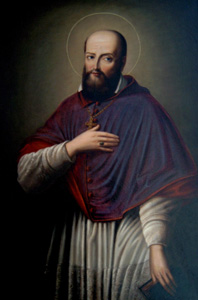
In the traditional calendar, today January 29, is the feast day of St. Francis de Sales (1567- 1622), Bishop of Geneva and the author of Introduction to the Devout Life, Treatise on the Love of God, and other works.*

This wonderful saint was born to aristocratic parents at Thorens, in the Duchy of Savoy (France). He was consecrated the Bishop of Geneva in 1602. At that time, the seat of the Bishop of Geneva was in Annecy in Savoy as the Calvinists controlled Geneva.

St. Francis de Sales fought the heresy of Calvinism and is said to have brought 72,000 heretics to the true Faith. Under his spiritual guidance, St. Jane Frances de Chantal founded the Order of the Visitation. He was beatified in 1661, canonized in 1665, and declared a Doctor of the Church in 1877.

In The Liturgical Year, Dom Gueranger said, "The angelic bishop Francis of Sales has a right to a distinguished position near the Crib of Jesus, on account of the sweetness of his virtues, the childlike simplicity of his heart, and the humility and tenderness of his love."

An touching example of St. Francis de Sales' "simplicity of heart" is found in his statement about St. Mary Magdalene in Introduction to the Devout Life (Part III, Chapter XXIX): "Simon the leper called Magdalene a sinner, because she had once lived a life of sin; but he lied, for she was a sinner no longer, but rather a very saintly penitent, and so our Lord Himself undertook her defense."

The saint died in Lyons. His body was brought to Annecy while his heart was kept at Lyons. He is buried at the Visitation Convent of Annecy. At the time of the French Revolution, the Visitation nuns took his heart from Lyons to Venice. According to the Catholic Encyclopedia, "A great number of wonderful favors have been obtained at his tomb in the Visitation Convent of Annecy."

Image:
St. Francis de Sales from Wikimedia Commons. In the public domain.
-----
*In the Novus Ordo calendar, his feast day was celebrated January 24.

Friday, October 30, 2009

Vatican Pressures Underground Chinese Bishop to Join Patriotic Association


As reported on October 29, 2009, "Sources told AsiaNews that after years in police custody Mgr An Shuxin [an underground bishop who was imprisoned for ten years] was torn about joining the CPCA [Chinese Patriotic Catholic Association]. Vatican and local sources confirm that the Congregation for the Evangelisation of Peoples (Propaganda Fide) put pressure on him . . . in the end, he obeyed the Vatican. Still, he was against joining the CPCA, an organisation that has arrested bishops and priests and shut down religious shrines, underground seminaries and communities for many years."

And despite the fact that he joined, the Patriotic Association "continues to monitor his movements, preventing him from taking part in conferences and meetings". . .

Meanwhile, three underground Chinese bishops, including Bishop Jia Zhiguo, remain "disappeared".

Read the rest of the story at Asia News.

Image:
Artistic depiction of the Chinese Martyrs (martyred 1648-1930)

Tuesday, October 27, 2009

Queen Dagmar and the Bishop


Readers might remember the earlier post on Dagmar (ca. 1189-1212/ 1213), Denmark's beloved medieval Catholic Queen. A charming ballad tells that through Dagmar's effort Bishop Valdemar of Schleswig was freed. He had been imprisoned for more than a decade in order to thwart his efforts to become the ruler of Denmark.

Image:
Herman Wilhelm Bissen's sculpture of Queen Dagmar, from Wikimedia Commons. In the public domain.

Friday, October 23, 2009

Fr. De Smet and the Flathead Indians


It is well known that "the blood of the martyrs is the seed of the Church" (Tertullian). One way in which the seed of the martyrdom of St. Isaac Jogues and the other North American Martyrs bore fruit was in the form of a band of Catholic Iroquois who many decades later encountered and evangelized the Flathead Indians of the Rocky Mountain area of North America.

The Flatheads had an oral tradition prophesying the arrival of black-robed, pale-faced men. Once the Iroquois clarified this oral tradition for the Flatheads, their desire for the Faith was so great that they made several long and arduous expeditions to St. Louis, Missouri, pleading with the bishop to send them a priest. Finally, the bishop sent them Fr. Pierre-Jean De Smet, a Belgian Jesuit. What ensued is a most remarkable story, told in two beautiful audio sermons, available for free mp3 download via these links:

The Flathead Indians and the Black Robes - Part I

The Flathead Indians and the Black Robes - Part II

Image:
Photograph of Fr. De Smet from Wikimedia Commons. In the public domain.

Friday, April 10, 2009

Chinese Christians and the Passion of Christ

Zenit reports on the ongoing abuse of Christians in China: "[M]any bishops have disappeared and their whereabouts are unknown; what is most probable is that many of them suffered a violent death and that their bodies were burnt to conceal any trace of the crimes." Read more here.

Thursday, April 9, 2009

Christ's Mandate


"A new commandment I give unto you: That you love one another, as I have loved you, that you also love one another. " (Jn. 13:34. Douay-Rheims version.)

Christ institutes the priesthood and the Holy Eucharist. Today is Maundy Thursday.

Tuesday, March 31, 2009

The Arrest of Bishop Jia Zhiguo


From today's Asia News

The occasion on which the above photograph of Bishop Jia Zhiguo was taken is not known to this blogger.

Monday, March 30, 2009

Update on Dong Lu, Hebei, and the Persecuted Chinese Church

Today from Asia News: Persecution in China as Vatican Meeting on China Opens

Sunday, March 8, 2009

Thursday, February 26, 2009

Cardinal Merry del Val and His Litany


Today is the 79th anniversary of the death of Rafael Cardinal Merry del Val y Zulueta (1865-1930) who served as Secretary of State during the reign of Saint Pius X. The Cardinal composed the Litany of Humility, a good prayer for Lent:

O Jesus! meek and humble of heart, hear me.
From the desire of being esteemed, Deliver me, Jesus.
From the desire of being loved, . . . (repeat: Deliver me, Jesus)
From the desire of being extolled, . . .
From the desire of being honored, . . .
From the desire of being praised, . . .
From the desire of being preferred to others, . . .
From the desire of being consulted, . . .
From the desire of being approved, . . .
From the fear of being humiliated, . . .
From the fear of being despised, . . .
From the fear of suffering rebukes, . . .
From the fear of being calumniated, . . .
From the fear of being forgotten, . . .
From the fear of being ridiculed, . . .
From the fear of being wronged, . . .
From the fear of being suspected, . . .
That others may be loved more than I, Jesus, grant me the grace to desire it
That others may be esteemed more than I, . . . (repeat:  Jesus, grant me the grace to desire it)
That in the opinion of the world others may increase and I may decrease, . . .
That others may be chosen and I set aside, . . .
That others may be praised and I unnoticed, . . .
That others may be preferred to me in everything, . . .
That others become holier than I, provided that I may become as holy as I should, Jesus, grant me the grace to desire it.