Showing posts with label CHURCH FLOWERS. Show all posts

Friday, May 16, 2025

White Flowers for Church Decoration


In Arranging Flowers for the Sanctuary, Patteson-Knight and St. Claire provide a list entitled, "Flowers Suitable for Church Decoration According to Color".

The first category on the list is white flowers. They are wonderful for church decoration because of the way they catch the light and because of their connotation of purity and innocence. I was surprised, however, to see some of the plants on the white flower list. One was geraniums, which I have never seen used in church. Moreover, I have some white geraniums in my garden and have found they do not last very long as cut flowers.

On the other hand, I was happy to see several flowers listed I'd never heard of. One of them was Ismene, which gets its name from Greek mythology. It is also called Peruvian Daffodil and is from the amaryllis family. Pictured above, Ismene is certainly a lovely bloom.

Here is Patteson-Knight and St. Claire's list of white flowers:

Amaryllis
Anemone
Aster
Azalea
Calla lily
Camellia
Carnation
Chrysanthemum
Clove pinks (grouped)
Cyclamen
Daffodil
Dahlia
Daisy (Boston or Shasta)
Delphinium
Foxglove
Gardenia
Geranium
Gladiolus
Hyacinth
Hydrangea
Iris
Ismene
Larkspur
Lilac
Lily (Madonna and Auratum)
Magnolia
Peony
Petunia
Phlox
Poinsettia
Ranunculus
Rhododendron
Rose
Scabiosa
Snapdragon
Stock
Sweetpea
Sweet William
Tulip
Viburnum
Yucca
Zinnia

Source:
Patteson-Knight, Francis, and St. Claire, Margaret McReynolds; Arranging Flowers for the Sanctuary (Harper & Bros., New York, 1961); p. 39.

Image:
Ismene, from Wikimedia Commons. In the public domain.

Tuesday, February 4, 2020

Calling All Church Flower Volunteers


Would you like to do as Gemma at Introibo- with Flowers does and share photographs of the altar or sanctuary flowers you have arranged?  If so, please submit a comment with a link to wherever you have already posted the image. This invitation is to church flower volunteers -- no professionals or others with commercial intentions please!

Monday, October 10, 2011

Saturday, September 11, 2010

The Five Elements of Floral Design


In addition to Adelaide B. Wilson's discussion of the six principles of floral design, she lists five elements of floral design. The elements are: line, form, pattern, texture, and color. One might think of the six principles as the active components while the elements are the matter on which they act in making the arrangement.

What Wilson has to say about the five elements can be summarized as follows:

Line refers to the overall framework or skeleton of the flower arrangement. It can include many subsidiary lines that are curved or straight, long or short. Wilson recommends working with the natural shape of the stem in creating line, and choosing the natural shape carefully. She cautions against trying to force an unnatural line on a stem as it might not remain in place.

Form refers to the shape of the bloom. Some are elliptical, some trumpet-shaped, others are spiked and so on. Also, the same flower has different forms when it is in bud, in half-bloom, and in full bloom. By using these forms in different combinations, one creates contrast and rhythm as described in the discussion of the six principles.

Pattern is the combination of line and form. It includes how empty spaces interrelate with the stems and blooms. Wilson recommends being careful not to crowd the flowers too closely as this impedes the construction of a pleasing pattern.

Texture refers to the roughness or smoothness of the bloom or foliage. It can be used in addition to color to create contrast. It adds shadow and depth. Wilson recommends being sensitive to the texture of other items in the church and also to whether the plant is so coarse in texture that it is too casual for church flowers.

Color is especially important in relation to rhythm and balance. Wilson points out that the visual weight of a color is significant. Light or pale colors seem lighter in weight than darker ones. Generally, it is better to use light colors high in the arrangement and dark colors lower, so that the dark colors give stability by means of horizontal balance.

Wilson advises the arranger to be sensitive to the liturgical colors. She also cautions that "great masses of brilliant flowers" are improper in a church setting because they draw too much attention. She notes that small amounts of lighter values of warm hues (yellows and reds) are effective for large areas whereas dark values of all colors, and blues and violets in all values, have a receding quality so that they tend to become invisible in a large church or a dim one.

The floral still-life above by Jan Davidsz de Heem illustrates all five elements of floral design. It can be an interesting exercise to use the painting to identify them.

Source:
Based on Wilson, Adelaide B.; Flower Arrangement for Churches (M. Barrows & Co., Inc.; New York, 1952), pp. 62-73.

Image:
Heem, "Flowers in a glass vase" (17th century; oil on canvas), from Wikimedia Commons. In the public domain.

Wednesday, August 11, 2010

Traditional Liturgical Colors and Church Flowers


This post is in answer to questions about whether at the traditional Latin Mass there are any liturgical norms regarding the color of altar flowers in relation to feast days.

As far as I have been able to ascertain, there are no norms about the color of the flowers. There are, of course, norms specifying the color of the priest's vestment and the altar frontal for the various days of the liturgical year. (The "frontals" are not to be confused with the altar cloths, which rest on top of the altar and drape over the sides. They are always white.)

Therefore, when planning church flowers one needs to take into account how the color or colors of the flowers will look with the colors of the vestment and altar frontal.


The basics are these:
White is for the seasons of Christmas and Easter, the feasts of Our Lord and Our Lady, and the feasts of angels, All Saints, and saints who are not martyrs.

Red is for the feasts of the Precious Blood, the Holy Ghost (e.g. Pentecost), the Holy Cross, apostles and martyrs.

Green is for Sundays and Ferias after Epiphany and after Pentecost.

Violet is for Advent and Lent (when no flowers should be used at all), on Rogation and Ember Days (except those of Pentecost when red is used), and for the season of Septuagesima and Vigils (except those of the Ascension and Pentecost).

Rose instead of violet may be used on Gaudete Sunday (during Advent) and Laetare Sunday (during Lent), and gold or silver and white may be used instead of white when white is prescribed.
Since white is the liturgical color for the feasts of Our Lady, such as the upcoming Solemnity of the Assumption, and the norms permit white to be substituted with gold, or with a combination of silver and white, one needs to check with the sacristan to find out which of these is going to be used and plan accordingly.

Beyond that, the best rule to keep in mind is that of the Ceremonial of Bishops: "The adornment and decor of a church should be such as to make the church a visible sign of love and reverence toward God." (No. 38.)

Image:
Photograph of altar with frontal (probably on Easter), from Sancta Missa.

Wednesday, July 28, 2010

Pink Flowers for Church Decoration


In their book Arranging Flowers for the Sanctuary, Patteson-Knight and St. Claire provide a list of pink and rose-colored flowers for church decoration.

The month of the Immaculate Heart (August) is coming soon. Since many depictions of the Immaculate Heart show the Blessed Mother's heart surrounded by a wreath of pink flowers (usually roses), August is an especially good time to decorate churches and sacred spaces in the home with pink flowers.

Here is the list of pink and rose flowers from Patteson-Knight and St. Claire:

Amaryllis, Anemone, Aster, Azalea
Calla lily, Camellia, Canna, Carnation, Chrysanthemum,
Clove Pink; Coxcomb; Cyclamen
Dahlia
Foxglove
Geranium, Gladiolus
Hyacinth, Hydrangea
Iris
Larkspur, Lilac, Lily
Magnolia
Peony, Petunia, Phlox, Poinsettia
Ranunculus, Rhododendron, Rose
Scabiosa, Snapdragon, Stock, Sweetpea, Sweet William
Tulip
Zinnia

By "amaryllis" the authors are referring to the flower commonly called "Pink Ladies" not hippeastrum, which is often marketed under the name amaryllis. Pink Ladies bloom in late summer.

I was astonished to see iris on the list since I had never heard of a pink iris before but I did find some images of pink irises online. They are very beautiful!

I also learned that Clove Pink (Dianthus caryophyllus) and Sweet William (Dianthus barbatus) are both types of carnations and can be very similar in appearance.

Geranium, gladiolus, petunia, phlox, rose, snapdragon, stock, and zinnia all bloom during the summer, so any of them might be a good choice for church and home decoration during August.

For a formal arrangement, I might use pink roses or cut-down gladiolas for form and pink snapdragons for height. For home, potted pink geraniums or phlox or a simple vase of pink stocks might work well.

Source:
Patteson-Knight, Francis and St. Claire, Margaret McReynolds; Arranging Flowers for the Sanctuary (Harper & Bros., New York, 1961), p. 39.

Image:
Pink gladiolas from Wikimedia Commons. In the public domain.

Thursday, June 24, 2010

The Six Principles of Floral Design


Adelaide B. Wilson has a way of making the art of flower arranging accessible to those of us who have not had the benefit of formal training. That information, in turn, helps in becoming more courageous about attempting a formal floral arrangement for the church or home rather than simply placing some nice flowers in a vase and letting it go at that.

According to Wilson, there are six principles underlying good floral design. They are: proportion, scale, balance, rhythm, contrast, and dominance. What follows is a summary of what I learned from reading Wilson's discussion:

Proportion is good when the arrangement is neither too large nor too small for the space in which it is placed.

Scale has to do with the relation of the size of various parts of the arrangement to the whole. Wilson uses the example of an oak tree, which has a strong trunk and large branches from which grow twigs and, in turn, from the twigs sprout leaves. This gradation is pleasing to the eye.

Balance is good when the arrangement appears stable and secure because it has a good base. Balance is particularly important with church flowers because if the arrangement appears unstable, it will be a distraction during the church service the same way, for instance, that a tilting candle is a distraction.

A stable arrangement can be accomplished by either symmetrical or asymmetrical balance. Formal symmetrical balance is where one side of the arrangement matches the other. That is, the same form and size is used on each side so that there is equal weight on each side. This type of balance is used when a pair of vases is employed.

Asymmetrical balance is achieved by using larger forms on one side and smaller ones on the other in such a way that they have the same visual weight.

Rhythm has to do with how the eye travels through the arrangement. It is achieved by repetition, by creating curving lines in the design, or through the use of color.

Dominance involves making a focal point by means of a bright dominant color, or a group of massed flowers, or a single large bloom.

Contrast relates to the use of foliage and buds or smaller flowers above or away from the dominant focal point such that the eye is drawn upward and outward from the focal point, then permitted to return to the point of importance. That point is usually (but does not have to be) at the rim of the vase -- or to some object to which the design has drawn the eye.

While Monet's "Still Life with Anenomes" (above) is not a flower arrangement as such, it shows very well how rhythm is created with repetition and the use of color. Notice how the green foliage between the blossoms gives rest to the eye as the eye moves from bloom to bloom.

Source:
Based on Wilson, Adelaide B.; Flower Arrangement for Churches (M. Barrows & Co., Inc.; New York, 1952), pp. 56-59.

Image:
Monet's "Still Life with Anemones" (1885), from Wikimedia Commons. In the public domain.

Friday, June 18, 2010

Hydrangeas


Hydrangeas are plentiful right now. While their full soft blooms may require an arrangement that is too large for altar flowers in a small traditional chapel, they are certainly suitable for adornment of a larger church. Moreover, in a small chapel, hydrangea arrangements can perhaps be used on pedestals in the sanctuary or elsewhere.

The composition above is by Adelaide B. Wilson. It combines hydrangeas with Hosta foliage -- a very interesting mix of textures.

Wilson discusses the arrangement in this lively commentary:
"I know of no more distinctive large bloom for the church. Coming at a season when there is little else of such important form, with variety of color from pale-green young blooms through a period of paper whiteness to final pink in many values, hydrangeas are indeed lovely. Even without the fine color and form, the texture of these flowers is suitable for any setting. . .

"Each bloom must be treated as a handsome individual. Bunched together in a mass, the heads lose their distinction. Foliage should be stripped off, the stalks put in deep water and, if the heads droop, a complete submersion given. However, the flowers should be fully dry before arranging or large puddles will collect. Strong foliage acts as a foil.

"Hosta with its glaucous sheen and strong veining here invokes a moving rhythm which travels from one mass to the next, giving each flower head a little alcove in which to sit in state. Exposed front and back of leaves add contrast.

"The copper urn is a substantial vase for large forms. It is simply made and came from the hands of a coppersmith of no special training but with an eye for proportion. Its unpolished red-brown is good with other metals and with wood and heavy fabrics. Such a vase is excellent for [a] sturdy pedestal or low table."
Source of text and image:
Wilson, Adelaide B.; Flower Arrangement for Churches (M. Barrows & Co., Inc.; New York, 1952), pp. 158-159.

Saturday, May 29, 2010

Orange and Golden Flowers for Church Decoration


The smallest category in Patteson-Knight and St. Claire's list of "Flowers Suitable for Church Decoration by Color" is that for orange flowers, which also includes golden flowers. The list has some surprises like the one for white flowers did. Among them are Butterfly Weed, Tritoma (Kniphofia) and Tithonia.


Butterfly weed, whose official name is asclepias tuberosa, gets its nickname from the fact that butterflies are especially drawn to its color and nectar. Tithonia (bottom image) grows best in Mexico, while Tritoma (also known as Kniphofia) is native to Africa. It is also called "torch lily" because it looks like a torch.

Aside from the three surprises, the orange flowers on the list are: calendula, chrysanthemum, coxcomb, dahlia, gladiolus, lily, ranunculus, rose, tulip, and zinnia.

Though perhaps fewer in type, orange flowers can work very well for decoration of the sanctuary. In fact, the best church flower arrangements I have seen in the past year were comprised of orange and golden flowers.

One display that I really loved featured orange alstromeria (top picture above). Somehow the orange and golden color really brought alive the gold of the candlesticks and other golden items on the altar and contrasted pleasantly with the white of the traditional linen altar cloth.

Orange or golden flowers seem particularly suitable for Corpus Christi, when the color of the vestments and altar frontals is white.  Another church flower book (by McClinton, an Anglican/ Episcopalian) says that "yellow and white or white and gold are the appropriate flowers" for Corpus Christi. She suggests using Shasta daisies, calla lilies, or white and yellow roses.

Source:
McClinton, Katherine Morrison, Flower Arrangement in the Church (Morehouse-Gorham Co., New York, 1958), p. 97.
Patteson-Knight, Francis and St. Claire, Margaret McReynolds; Arranging Flowers for the Sanctuary (Harper & Bros., New York, 1961), p. 40.

Images:
Top - Alstromeria, from Wikimedia Commons. Some rights reserved.
Bottom - Tithonia, from Wikimedia Commons. Some rights reserved.

Wednesday, May 12, 2010

Color in Church Flower Arrangements


Please note:  If you are visiting this post because you are looking for information about the liturgical colors for different feast days and seasons, you will find what you are looking for in my post "Traditional Liturgical Colors and Church Flowers".  This post is about how to use color effectively.

As a follow-up to the discussion of color in church flower arrangements in the post Altar Flowers, here is some advice from Patteson-Knight and St. Claire on the same topic:
"[T]he cool or receding tones are the least satisfactory, especially in larger sanctuaries. Cool colors lose a substantial amount of their eye appeal under artificial light. The unit of any arrangement, in fact, will change its tones when it is assembled under one lighting condition but is exhibited under another. No color is constant to itself, but is always subject to variation in different degrees of natural or artificial light.

"A good analogous arrangement, therefore, will contain one of the more steady, more intense colors of the warm range. If composed solely of the receding tints, it will tend to wash out and become nondescript. A monochromatic arrangement of reds, yellows, or orange shades has the best chance of success, particularly in the subdued illumination of many churches. The best monochromatic design will use gradations of color, with more or less of the darker or lighter values as the arranger wishes, but never in the same amount.

"The carrying power of color is no more important in any flower arrangement than when in a church. It must first overcome the demands of distance, then lighting and background. Pastel shades will thin out and merge unless they are backed with greens. Blue and violet fade in the distance or become muddy under poor illumination. Almost nothing stands out against ornate or lavish decoration inside a church. This is why the altar, with its simplicity, is the best area for placing flowers and why, also, color in flowers is often needed to accent the plain cloths and simple fittings.

"Sometimes light colors will succeed against a dark [background]. They may also give a happy result if the [sanctuary] or the altar is a rigid white. Light flowers against a light background will show to advantage in a darkened church when they are framed in green. This will give them a dimension they would not have alone. Green, however, does not show up well in front of [a dark background]. Against its own shades or against purple or maroon, green loses visibility.

"One color must always predominate; more than three used together require artful assembly. Too many colors establish a feeling of discord. This means that the flowers will not succeed in creating a logical and simple arrangement.

"The exclusive use of green to decorate a church makes an effective display, but it has its limitations. Planters look well, and, of course, so do palms and palm fronds. Palm Sunday, in fact, is one [day] for which a green motif might be planned. The altar can be backed with green foliage . . . Green foliage lends itself well to vertical arrangements. Therefore, a little of it may be made to serve much, but this is often only possible in smaller sanctuaries.

"The wise arranger, seeking harmony of colors in her decorations, will look about first at the altar frontal, the . . . reredos, the color of the walls, and the carpet. She consults the church's interior architecture before creating her own accent in the place. If the arrangements are for a feast or for a saint's day, thought must be given to the liturgical color. Also the availability of flowers at any time will determine the colors. The seasons put their penalties on the arranger as much as do the obstinate skills of her craft."
Source:
Patteson-Knight, Francis, and St. Claire, Margaret McReynolds; Arranging Flowers for the Sanctuary (Harper and Bros., New York, 1961), pp. 82-84.

Image:
Photograph of red anthurium, from Wikimedia Commons. In the public domain. It was this blogger's experience that red anthurium worked very well as a church flower in a large Gothic style church.

Saturday, January 2, 2010

Scale, Proportion, and Balance in Church Flower Arrangements


In their book, Arranging Flowers for the Sanctuary (1961), Knight and St. Claire had this to say on the topic of scale, proportion, and balance in church flower arrangements:
"Selecting and arranging plant material has two aims: order and beauty. The arranger must keep these two goals uppermost and observe known principles for their attainment.

"The most often confused of such principles are scale and proportion. Both are important in successful flower arranging.

"Scale is the relationship between the sizes of the component parts of an arrangement. The relative sizes of the flowers as well as the relationship between the arrangement and the size of the area it decorates are both involved. A well-scaled arrangement for a smaller chapel would be based on Fashion roses rather than an amaryllis. Also, an amaryllis is much too large for a vertical container six inches in height.

"Proportion is the size relationship of one portion of the arrangement to another. Remember that the visual weight of plant material has much to do with the height of an arrangement. Heavy material used in a ratio of one and a half to twice the height of the container is the general rule. Light, airy material may be from two and a half to three time the height of the container and still be in proper proportion. However, if the church is large, distance tends to make arrangements diminish in height. A better appearance is attained if the plant material is at least three times the height of the container.

"Balance is another important principle, especially in church flower arranging, since the finished design must be firmly fixed. There are two types of balance. Symmetrical balance is the most common in churches. It is always quiet, dignified, and impressive, if sometimes static. This type of balance is achieved by placing an equal amount of plant material on both sides of an imaginary center line drawn through the middle of the plant material and container. Both sides are practically the same.

"The second type of balance, and one more difficult to complete, is asymmetrical. This type relies on purely visual effects for its success. The two sides here may differ in form and color but have equal weight. At all times the whole arrangement depends on the eye's measurement and evaluation.

"The three types of symmetrically balanced arrangements most often seen in church are (1) massed oval, (2) massed triangle, and (3) massed vertical. The type of arrangement to be used must depend on the architecture of the church and the kind of reredos. With Gothic architecture, a vertical arrangement looks well. Baroque or Byzantine, on the other hand, calls for an oval or a triangle. In contemporary settings, a bold triangle or vertical arrangement looks best.

"In a small church or a simple chapel a rather loose informal type of arrangement is suitable. A formal chapel demands a more tightly massed arrangement, yet one that should be kept dignified and simple."
Source:
Patteson-Knight, Francis and St. Claire, Margaret McReynolds; Arranging Flowers for the Sanctuary (Harper & Bros., New York, 1961), pp. 76-79. (Emphasis added.)

Image:
Patteson-Knight, Francis; line drawing of the three types of massed arrangements, at p. 78 of the above-cited book.

Tuesday, November 3, 2009

Foliage and Form in Church Flower Arrangements - Part 2


This is the second part of a two-part post on foliage and form in church flower arrangements relying on Katherine Morrison McClinton's 1944 book, Flower Arrangement in the Church. Here McClinton describes the three types of massed arrangements she views as especially suitable for church decoration: the massed triangle, the massed oval, and the massed vertical:
"HOW TO MAKE A MASSED TRIANGLE

"In making a massed triangle arrangement, always start with a tall center stalk as your primary line. Then measure two stalks of identical length and place them horizontally to each side of the vase. Continue filling in the triangle with flowers. Place the heavy or dark colored flowers for emphasis in the massed triangle low in the vase and radiate the second triangle with stalks of lighter toned flowers back of the small triangle. Combinations of flowers which are excellent for this arrangement are amaryllis with a delphinium fan; roses with delphinium; roses with stock and anemones; tulips with dogwood; Madonna lilies or peonies with double syringa. It is not necessary always to have a contrast in hue as two or more different varieties of flowers give a contrast in texture which is interesting. The same floral design may be made with one variety of flower backed with a fan of leaves. . . .

"The shape and proportion of the triangle arrangement may vary with the size of the arrangement desired, as this arrangement can be made in a small altar vase or a large urn vase to be set [elsewhere in the sanctuary] . . .

"MAKING A MASSED OVAL ARRANGEMENT

"In making an oval arrangement, first place the center or core flowers low and firm near the base and the other flowers can be made to radiate about this center. An oval arrangement should have depth, as well as height and breadth, and this can be accomplished by turning some flowers to the side and others to the front. An oval arrangement is especially suited to vases with bulges or full-curved contours and to churches with oval archways.

"MAKING A MASSED VERTICAL ARRANGEMENT

"A massed vertical arrangement is particularly suitable for a simple, tall vase, although a tall urn may be used. First of all, place the vertical stalks, then place the secondary stalks which may be down near the vase or may ascend rhythmically alongside the vertical so that they too form a vertical line. Contrast in flower form is necessary to make this type of arrangement successful. For the tall vertical stock, delphinium or lilac may be used, while the secondary line may be built up with roses, asters, or daffodils of various length stems."
Unfortunately, McClinton does not provide diagrams, but it is fairly easy to visualize what she describes, and a little trial and error ought to yield a good result.

Note that in part 1, posted previously, McClinton said that the massed vertical arrangement is especially suited to narrow spaces, narrow vases, and Gothic architecture. In small traditional chapels, one must usually work with narrow spaces (the altar shelf), so vertical arrangements in narrow vases might be best. On the other hand, if the sanctuary is large enough, with the priest's permission larger arrangements could be placed on pedestals elsewhere within the sanctuary, such as on either side of the altar.

Source:
McClinton, Katherine Morrison; Flower Arrangement in the Church (Morehouse-Gorham Co., New York, 1944, 1958 edition); pp. 49-52.

Image:
"Hippeastrum Pardinum", from Wikimedia Commons. In the public domain.

Thursday, October 29, 2009

Foliage and Form in Church Flower Arrangements - Part 1


This is the first part of a two-part post on foliage and form in church flower arrangements relying on Katherine Morrison McClinton's 1944 book, Flower Arrangement in the Church.

McClinton recognizes that since flowers in the sanctuary are first and foremost an offering to God, their arrangement must be worthy of that offering. She is also alert to the secondary purpose of church flowers, which is to ennoble the viewer and lift his or her heart and mind to God. A proper presentation is integral to that purpose as well:
"[F]lowers for church must be seen at a distance. Therefore, the effect should be bold and clear cut." . . .

"To be sure that flowers are effective at a distance you must not only give the flowers form but also the bouquet itself must have shape and mass. A massed arrangement of many flowers is the best type of arrangement. Also, because you want a certain dignity and formality in the church, the mass arrangement which has a formal balance is the best. Mass arrangements based on the triangle or oval are more traditional; however, you can arrange a massing of flowers with a structure line that leads [the eye to] the center [of the altar]. A certain severity of line is necessary if your design is to carry at the back of the church. Also, the color must be well defined.

"There are three types of mass arrangements especially suitable to church decoration: the massed triangle, the massed oval, and the massed vertical. Which type you choose will depend upon the vases obtainable, upon the space to be occupied by the flower arrangement, and to a certain extent upon the architectural lines of the church itself. For narrow spaces and all narrow vases and Gothic architecture, the massed vertical or triangle may seem more suitable. . . .

"If the flowers which you are using do not have interesting leaves, or if the leaves wilt easily, you can improve the arrangement by picking off the leaves and substituting more distinctive foliage. There are many leaves from both garden and house plants that can be used. Among the foliage that is particularly decorative are the leaves of the iris, gladiolus, and yucca, all of a tall, pointed contour; funkia [also known as hosta], canna, rubber plant, and magnolia leaves, which are large and heavy in effect; and pandanus, coleus, croton, caladium, and begonia leaves, which are especially colorful, as well as shapely. Of course, certain greenery, such as huckleberry, eucalyptus, magnolia, and ivy is most useful, and even cypress, and sword ferns can often be used as background material to set off a few blossoms. . . .

"It is well to remember that a mass arrangement does not mean a thick tight mass of flowers stuffed into a vase. A mass arrangement should have definite lines and should not be flat or even on the top or at the sides. Avoid this by using flowers with stems of various lengths grouped around the center primal stalk. The middle center mass should be strong and full, and tied close to the vase. These factors are applicable to massed oval as well as to the massed triangle arrangement."
To be continued . . .

Source:
McClinton, Katherine Morrison; Flower Arrangement in the Church (Morehouse-Gorham Co., New York, 1944, 1958 edition); pp. 48-51.

Image:
Canna "Auguste Ferrier", from Wikimedia Commons. In the public domain.
(Canna's decorative foliage is one of those recommended by McClinton for use in church flower arrangements.)

Thursday, August 27, 2009

Altar Flowers


According to an article on altar vases in the 1913 Catholic Encyclopedia, the rules regarding altar flowers are as follows:
“The Caeremoniale Episcoporum (I, xii, n. 12) says that between the candlesticks on the altar may be placed natural or artificial flowers, which are certainly appropriate ornaments of the altar. The flowers referred to are cut flowers, leaves, and ferns, rather than plants imbedded in soil in large flowerpots, although the latter may fitly be used for the decoration of the sanctuary around the altar. If artificial flowers are used they ought to be made of superior material, as the word serico (ibid.) evidently implies, and represent with some accuracy the natural variations. Flowers of paper, cheap muslin, or calico, and other inferior materials, and such as are old and soiled, should never be allowed on the altar."
While there is something to be said for honoring God with elaborate floral designs, the best arrangements are usually the simplest. Perhaps this is because the emphasis is not on the skill and imagination of the flower arranger but on the beauty placed in nature by its Creator. Moreover, an elaborate arrangement may draw the attention of the faithful away from the Holy Sacrifice of the Mass.

A simple arrangement is in any event the most suitable for a traditional Latin Mass where the altar vases must fit between the candlesticks on the altar shelf, which is usually rather narrow.

Perhaps the most important consideration is that the altar flowers should be harmonious with the color of the vestments and altar frontals for the day according to the liturgical norms. There is nothing wrong with simply using several blooms of a single color, varying the height of the stems a little, and adding a little green foliage if necessary.

If a flower arranger wants to work more with color, however, an old book on church flowers gives some sound advice regarding color combinations:
“Color in church flower arrangements is . . . a different problem from color as used in more intimate arrangements. Factors determining the color to be used are the architectural decorations of the church and the color of the vestments or frontal of the day. . . . There are three types of color combinations most suitable for church arrangements: the monochromatic or one-color scheme, the analogous or related scheme, and the complementary or contrasting color scheme. Perhaps the monochromatic is the most effective, being the simplest and easiest to make successfully.

“To make a monochromatic flower arrangement use flowers of different values or tones of one hue. A monochromatic scheme in blue could consist of large and dark blue delphinium and dark cornflowers or deep blue agapanthus. Red carnations, because they are available in many tones from dark to light, will make an effective monochromatic bouquet. The red can range from deep red to a pink, almost white tone.

"The analogous color scheme is the next easiest to create. It is made by using flowers of different colors in sequence as they appear on a color wheel, thus -- red, red-orange, orange, orange-yellow, yellow. Such a combination of warm colors may be made of chrysanthemums in an autumn arrangement. However, it is important to remember to group the different colors together, for, if they are scattered and mixed together in the vase, the effect will not be the same. Analogous color schemes may be warm or cold, depending on which side of the color wheel you use. The warm colors are red and orange and their intermediates, while the cold colors are blue and green and any colors that contain any blue or green.

“A complementary or contrasting color scheme uses colors from opposite sides of the color wheel; that is, two hues which complement each other. Simple complementaries are blue and orange, red and green, violet and yellow. To be successful, the two colors should be of equal intensity but of varying amounts. Cool and warm colors can be combined. It is necessary, also, to consider the lightness and darkness of the flowers used and, if a strong and brilliant arrangement is desired, use flowers of the same values, except perhaps at the center of interest where a stronger or deeper value may be effectively used.

“. . . If soft effects are desired various shades of pink, blue, and lavender may be combined or ‘interlaced’ so that from a distance they seem united in one delicate blend of color. However a triad color scheme, that is, one based on three primary colors, red, blue and yellow, which usually results in what is called a mixed bouquet, is not so satisfactory for the church. The triad color scheme, being more complex, does not have the directness and simplicity of the other types of color scheme.”
Source:
McClinton, Katherine Morrison; Flower Arrangement in the Church (Morehouse-Gorham Co., New York, 1944, 1958 edition); pp. 52-55.

Image:
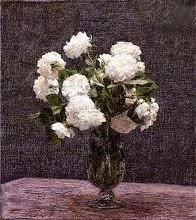
Fantin-Latour’s “White Roses”, from Wikimedia Commons. In the public domain.