Les Dames du Bois de Boulogne (1945) is the second feature-length film by Catholic director Robert Bresson (1901-1999). It followed Les Anges du péché (1943), the screenplay for which was written with the help of a French Dominican priest, Fr. Raymond Leopold Bruckberger, and playwright Jean Giraudoux.
Les Dames was filmed in France during the German occupation. It is based on a story-within-a-story in Denis Diderot's late 18th century novel Jacques le fataliste. Diderot, a writer of the so-called Enlightenment, was no friend of the Church. The story as adapted for Bresson's film by Jean Cocteau, however, is thematically Catholic.
Set in Paris around the time the film was made, the story line is simple: after a two-year relationship, Jean's ardor for his lover, Hélène, has cooled. Hélène pretends the same has happened to her. Jean is relieved and suggests they maintain a friendship. Hélène appears to do so while executing a vicious revenge.
Hélène's plan begins with locating a mother and daughter whom she had known when she previously lived in the country. Three years prior to the setting of the story, the widowed mother had moved in to Paris with her daughter Agnès (now 19 or 20 years of age). Once affluent, they had almost immediately become destitute after the move due to some financial reverses. Agnès, a talented dancer, had given up her hopes of a legitimate career and become a popular cabaret dancer in order to support her mother and herself. Although it is not entirely clear in Bresson's version, Agnès was perhaps a prostitute, as was the woman in Diderot's story. At least she is viewed as someone who is or might as well be, and at one point she calls herself a tramp.
Hélène pretends to rescue the mother and Agnès from their fallen life. She pays their debts and provides them with an apartment. Agnès stops dancing and the women rarely go out. Then Hélène carefully orchestrates a meeting between Jean and the two women at the Bois du Boulogne, a Parisian park, knowing that Jean will be attracted to Agnès. As a result, with Hélène carefully manipulating the situation, Jean not only falls in love with Agnès but becomes obsessed with her to the point of near insanity.
Unable to conduct a normal courtship because of Hélène's control and believing Agnès and her mother to be women of impeccable virtue, Jean marries Agnès. Hélène arranges the marriage and orchestrates the wedding, seeing to it that Agnès' former male admirers are all there. Then, just after the ceremony has ended, Hélène, with great delight, reveals Agnès' past to Jean. Hélène's plan of revenge fails, however, because Jean and Agnès have come to a true love for one another that triumphs over evil and death.
Some critics have incorrectly labeled the film a melodrama. They need to check their dictionaries because a melodrama is a drama that exaggerates emotion while lacking characterization. This film is full of characterization: the dark intelligence of Hélène; the obsessed Jean; the mother who subjectively loves Agnès but is so lacking in moral fiber that she would rather let her daughter sell herself than sell her own furniture; and Agnès, who has difficulty accepting the consequences of her own actions. While the ending of the film is quite emotional, the emotions displayed then and throughout are appropriate to the story.
Not only is there characterization but there is character development. Early in the tale, we Americans might describe Jean as a "poor little rich boy", petulant and wilful. We see that he loves beautiful objects, and Hélène has been an object to him. But he is drawn by Agnès' authenticity. He likes the way she looks at people -- direct and shy at the same time. She seems more like a country girl than a city sophisticate. He sees her as "childlike and noble". He tells Hélène, "Agnès' face is like a wound across my heart." Thus, grace enters his life. Suffering lies ahead, but by the end of the film, he has grown to authentic manhood.
In one truly charming scene, as the result of a hint carefully dropped by Hélène, Jean goes to the area where two women live and waits, hoping for a chance encounter with Agnès. By the time Agnès appears, it is raining. Agnès rebuffs Jean, but he is reluctant to leave. Finally, Agnès says, "Do you like rain that much?" Jean smiles, looks up, and asks, "Is it raining?"
This encounter is more than a charming scene, however, because Agnès then gives Jean her mother's umbrella, and that event begins a rite of passage during which Agnès leaves her mother's ambit and comes under Jean's protection.
Not only has Agnès wounded Jean's heart but he has pierced Agnès' heart as well. At the beginning of the film, Agnès is abrasive and rather tomboyish. When she first goes to the apartment Hélène has provided, she uses her suitcase to push the door open roughly, then strides inside. As the story goes on, however, she becomes more feminine and womanly in her movements and gestures. And, as a genuine love for Jean comes to bloom on the night of their marriage, Agnès comes to terms with her past. Not only has she led a fallen life but she has betrayed Jean by marrying him without disclosing her notoriety. Humbled by love and contrition, Agnès begs Jean, "Show me a corner of your house where I can live."
Like all of Bresson's films, this one is visually exquisite, and like all of his early films it is in black and white. Although not as stark as his later works, it nevertheless has many elements that are noticeably "Bressonian". Among them are: a rainfall (and in this story also a waterfall) symbolizing purification; a grotto which the principal characters enter and emerge from having received graces that will slowly manifest over time; a critical moment when a character's actions seem to have left him or her without a choice regarding the future; and, finally, the redemptive outcome that is found in most (although not all) of Bresson's films.
The film is available in a high quality DVD in French with optional English subtitles. Admirably, there are no bedroom scenes. Agnès' dress and behavior are immodest at the cabaret, however, and there is a sordid event at the mother's apartment while Agnès is dancing with one of her admirers. These scenes are all contained within about five minutes of the DVD and can easily be avoided by fast-forwarding from the point of 11:30 minutes to about 16:45 minutes. Before and after that segment there is nothing objectionable although, as must be clear from the foregoing, this is not a film for children or young teenagers.
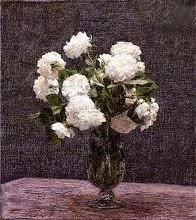
Image:
Jean Baptiste Camille Corot's "In the Park" (1862). Oil on canvas. From the Web Gallery of Art.