Showing posts with label FILM. Show all posts

Thursday, February 15, 2024

A Handful of Dust (1988)


Note:  I updated this post on 2-15-2024 to add the image and hopefully improve my statements about fallen human nature.

Directed by Charles Sturridge and produced by Derek Granger -- both of Brideshead Revisited fame --  A Handful of Dust is a made-for-television film based on a novel by Evelyn Waugh.  It is available in DVD format.

The story is set sometime between the two world wars. Tony Last (James Wilby) is the squire of a British country estate, Hetton,  on which rests his ancestral home.  (Although it is not clear from the movie, the novel describes Hetton as a former abbey.  One supposes it came into Last's family's hands during Henry VIII's dissolution of the monasteries.  Afterward, it went through various structural changes and was redone in the neo-Gothic style during the 19th century.)

Tony loves Hetton and sacrifices a great deal to maintain it in the condition and use he believes befits it and his family history.  Yet, aside from the many servants, the only occupants are Tony, his son John Andrew, and his physically lovely but shallow wife, Brenda (Kristin Scott Thomas).  Tony is an attentive father, kind to the servants, and magnanimous to the villagers but has little interest in entertaining "gossips" from the city or spending time in London.

In response to a very casual invitation from Tony, a young man of poor means and remote social acquaintance, John Beaver (Rupert Graves), shows up at Hetton one weekend with the blessing of his opportunistic mother (Judi Dench).  Brenda does not hesitate long in letting Beaver know how little she cares for Hetton and how bored she is with Tony.

Beaver is more than willing to encourage Brenda and before long Brenda embarks on a campaign to make Beaver her plaything.  Brenda fancies Beaver and the idea of grooming him for her own pleasure appeals to her.  Rarely has a woman in book or film been so lacking in scruples about adultery or this particular form of it.  Brenda's eagerness and Beaver's mother's encouragement soon overcome Beaver's mild resistance to being bought, paid for, and trained.

Brenda takes a flat in London to facilitate her affair with Beaver and claims to take up the study of economics in order to justify her long stints in London.  Everyone in their social circle knows what is going on but no one tells Tony. One weekend Brenda goes home to sleep with Tony to keep him happy.  Naively, Tony responds with a heart-breaking gratitude.

When the couple's son, John Andrew, is tragically killed in a horse-riding accident on the day of a fox hunt, Brenda is initially relieved that the John who has died is her son John Andrew, not her lover John Beaver.  Soon there is a complete breakdown of Tony and Brenda's marriage and Brenda demands a divorce.  Tony, with predictable decency, agrees not only to the divorce but to take on the role of the adulterer for legal purposes.  But, when Tony discovers that Brenda's demands are such that he would have to give up Hetton in order to meet them, Tony finally understands that -- as he aptly puts it -- he would be giving up Hetton to buy Beaver for Brenda.  At that point, Tony has finally reached his limit.

The story then makes a very abrupt shift from realism to something closer to surrealism.  Abandoning the legal proceedings so as not to surrender Hetton, Tony goes to the jungle of South America with an eccentric explorer who claims to "know the Indian mind" and has brought along mechanical mice to charm the natives.  Unfortunately, the explorer does not know the Indian mind well enough to stay alive in the jungle and Tony is soon at the mercy of -- and imprisoned by -- a local chief "Mr. Todd" (Alec Guinness) who is half English and half native.  Todd is an illiterate who forces Tony to read volume after volume of Dickens to him.

It is very difficult to make the leap from the first to the second part of the story until one comprehends the theme that ties the two together -- the dark side of fallen man.  The Guinness character's use of Tony for his own pleasure is not a great deal different than Brenda's use of Beaver for hers.  The natives' festivities are only superficially unlike those of the London socialites.

The women in the story are particularly loathsome. Brenda is having her sole (yes, the bottom of her foot, not her soul) read by a fortune teller at a women's party in London when the news arrives that John Andrew is dead.  Tony seeks consolation from a rather ghoulish American woman ("Mrs. Rattery") who had flown her own plane into Hetton the day of the accident.  She is a mother who has abandoned her children or lost them to their father's custody. The best she can do is insist that Tony play a child's card game with her. A girl astride a motor scooter is part of the congestion that produces the accident that causes the death of John Andrew.   An ugly native woman bargains roughly with the explorer and demands cigarettes of Tony. The prostitute who is supposed to pose as Tony's partner in adultery during the divorce effort at Brighton is too lazy to even do the job she's been hired for. She brings along her daughter and the daughter too is rude and demanding. The only appealing (and womanly) woman in the entire story is the nanny who tenderly selects the clothing for John Andrew's burial.

Of the wealth packed away in this story and this film, more is revealed on subsequent viewings.  And for me at least, there is more to be revealed.  That is, I am still trying to make sense of the presence of foxes at different points in the story.  Brenda wears fox fur stoles in different colors throughout the film. At the very end of the film, the foxes are white and they are in cages. Brenda is shown them and looks at them wistfully.  I suspect the foxes are an allusion to the Canticle of Canticles 2:15, "Catch us the little foxes that destroy the vines:  for our vineyard hath flourished."  The Church understands the foxes to be false teachers that seek to destroy the vineyard of the Lord, i.e. the Church.

Ultimately, A Handful of Dust is a parable about original sin, concupiscence, and man's need for redemption.  Tony's goodness is a natural goodness uninformed by an adult religiosity. Tony is an Anglican who loved to take John Andrew to church on Sunday and sing the hymns but he did not want to talk with the vicar about religion after John Andrew died.  Later, when asked, Tony said he guessed he believed in God but he had not thought much about it.

The novel A Handful of Dust was published four years after Waugh converted to Catholicism.  Waugh does not preach, but the sermon is there in the form of Hetton: as its label indicates, neo-Gothic architecture was inspired by the medieval period.  And, of course, it was during the Middle Ages that authentic Christianity most thoroughly imbued society.  In clinging to Hetton, Tony is unconsciously clinging to the Church, which alone possesses the cure for wounded human nature.


Tuesday, July 7, 2020

A Man for All Seasons (1988)


This is a review of the made-for-television film A Man for All Seasons (1988) directed by and starring Charlton Heston as St. Thomas More.  It is based on Robert Bolt's play of the same name and is not to be confused with the 1966 version starring Paul Scofield.  The 1988 version is available on DVD and is available from the usual outlets.

I have read several reviews of the 1988 version.  They invariably compare it with the 1966 film, some preferring one and some the other.  One or the other critic fails to realize that Heston was no stranger to the play -- he was More in several off-Broadway and U.K. performances just as Scofield was More on the West End and Broadway.

Personally, I much prefer the 1988 Heston version which, among other things, is more faithful to the script of the play (including the "common man" and the Spanish ambassador characters ).

Some reviewers complain that Heston did not resemble More physically while they imagine that Scofield did.  I am not so sure that is true but even if it were, the inner man is more important than the externals.

In my view, Heston conveyed the persona of More more accurately than Scofield, whose More was aloof and rather condescending.  The real More was humble in the truest sense of the word and thoroughly engaged in everything in his environs -- from the pets he kept (including a monkey) to his natural and acquired children and their spouses, to his own feisty mate Lady Alice, to his father and brother-in-law and many friends, to the citizenry of London whom he served in various legal capacities, to the Church and to the England that cost him his life.

Of central importance is that the Heston version, being more faithful to the play, provides thought-provoking dialogue about More's views of law and conscience upon which one can reflect. 

In his  1999 article in First Things entitled, "Thomas More for Our Season", the late Judge Robert H. Bork opined that Bolt got More right with regard to the saint's understanding of these subjects:
"Again [in Bolt's play, More] says: 'God made the angels to show Him splendor—as He made animals for innocence and plants for their simplicity. But man He made to serve Him wittily, in the tangle of his mind.' Not in the pride and certainty of the individual conscience, but in the tangle of his mind."
A viewer of the film should remember this or he may become confused by the film's several references to More's "private conscience". In fact, More's conscience was not "private" -- it was Catholic.

As Peter Ackroyd suggests in his profoundly moving biography of More, the very word "conscience" implies thinking or knowing "with" (con).  Thinking with the Church is the essence of More's conscience.

In the First Things article, Judge Bork points out that the idea of a individual, private conscience is a Protestant view, not a Catholic one:  In fact, to Judge Bork, "More’s behavior may be seen as submission to external authority, a conscious and difficult denial of self."

While in a sense one's conscience is "private" in that each individual bears responsibility for his moral actions, we have a duty to form our conscience in accordance with the teachings of the Church.

Here it is illuminating to quote from the saint himself -- from his response when he was being coerced to agree with Henry VIII's repugnant policies.

More referred to the church militant elsewhere in Christendom and to the church triumphant in heaven.  Then he asked whether he was bound to conform his conscience "to the Council of one Realm against the general Council of Christendom".  Thus we see that in More's own view his conscience was anything but private; it was formed by and answered to the teachings of the universal Church.  Its locus was eternity.

See the movie and think on these things; they are as relevant now as they were nearly 500 years ago.

Image:   Thomas More and his daughter Meg in his cell in the Tower of London by John Rogers Herbert, 1844.  From Wikimedia Commons.  In the public domain.

Wednesday, September 21, 2011

The Laziest Gal in Town (Stage Fright, 1950)


I recently viewed Stage Fright, a 1950 motion picture directed by Alfred Hitchcock in which Marlene Dietrich has a major role. Much that happens in this movie is in keeping with one of Mr. Hitchcock's major themes:   the complexity of the human soul.

In Hitchcock's pictures, seemingly "good" people often reveal themselves to be anything but, and seemingly "bad" people sometimes do good things. Occasionally, they even rise to the level of sacrificing themselves for the common good.

Hitchcock was Catholic and the view he presents of human beings wounded by original and personal sin but still bearing the image of God is of course thoroughly Catholic.

In Stage Fright, Marlene Dietrich is a very bad woman indeed (although somewhat less thoroughly evil than she initially seems).

During the film, Dietrich (an actress and singer in the movie) performs before a theatre audience a piece called "The Laziest Gal in Town". Cole Porter wrote the number specifically for this movie.

The idea of the song is that while Dietrich would like the reward of selling her sexual favors (like the "gals" who get "money to burn"), and while she is attractive enough  ("it's not 'cause I couldn't"), and she is not morally opposed ("it's not 'cause I shouldn't")  -- she doesn't sell herself because it's just too much trouble ("it's simply because I'm the laziest gal in town").

I couldn't help but think that this song provides a great negative example of purity of intention.  That is, we Catholics strive not only to avoid evil and do good but to do these things solely for the love of God -- we strive to purify our intention.  The Dietrich character, however, refrains from sin not out of love for God or even to avoid damnation, but simply because of sloth.

I don't know whether Cole Porter had any of this in mind when he wrote the song but I rather like to think that Mr. Hitchcock very skillfully slipped a sermon on spiritual theology into this film.

Postscript:   Incidentally, the female lead in Stage Fright, Jane Wyman, converted to Catholicism in 1953 and became a Dominican tertiary.  It is said she was buried in a Dominican habit.

Friday, August 12, 2011

The Ten Most Elegant Motion Pictures

This review was updated 8-9-2012

Of all the movies I've seen, I consider those listed below the most elegant.  Many are in black and white and all but two are from one or the other Catholic director.  (Boleslawski, Bresson, Ford, Hitchcock, McCarey, Rohmer and Scorsese were/are Catholic. Ophuls was not.)

For the time being at least, I have listed the films in alphabetical order rather than ranked them:

An Affair to Remember (1957, Leo McCarey)

I Confess (1953, Alfred Hitchcock)

L'Anglaise et le Duc (2002, Eric Rohmer)

Les Dames du Bois de Boulogne (1945, Robert Bresson)

Letter from an Unknown Woman (1948, Max Ophuls)

Notorious (1946, Alfred Hitchcock)

The Age of Innocence (1993, Martin Scorsese)

The Earrings of Madame de (1953, Max Ophuls)

The Fugitive (1947, John Ford)

The Painted Veil (1934, Ryszard Boleslawski)

Thursday, May 12, 2011

Green Dolphin Street on Old Time Radio


For those of us who long ago rid ourselves of the scourge of television, there are difficult moments when an old movie is only available on VHS and not DVD.  For quite some time, I have been wanting to watch Green Dolphin Street (1947), a drama with a godly resolution of several romantic conflicts.  You can read a little about the movie in the Wikipedia article here and a Catholic review by Elena Maria Vidal here.

Much to my delight, I recently discovered that a 1949 radio adaptation of the story by Lux Radio Theater is available in mp3 format at the Internet Archive Old Time Radio site here.  (Go to the link and then scroll down the page.) At the same site, one can find many radio adaptations of other classic movies.  These include several romantic comedies by Catholic director Leo McCarey -- Love Affair, The Awful Truth, and My Favorite Wife.  Enjoy!

Saturday, April 2, 2011

The Quiet American (1958)


The Quiet American (1958) is a black and white film directed and produced by Joseph L. Mankiewicz, who also wrote the screenplay.  It is based on a novel of the same name by Graham Greene and was followed by a remake in 2002.

The motion picture stars Audie Murphy as the American, Michael Redgrave as Thomas Fowler, Giorgia Moll as Phuong, and Claude Dauphin as the French police inspector, Vigot.

A multi-layered story with political intrigue, a detective story, and a romantic triangle, the film opens with the death by drowning of the American, an event that occurs during the Chinese New Year's celebration in Saigon, Vietnam, in 1952.  The story is then told for the most part in flashbacks related by Fowler as Inspector Vigot investigates and questions Fowler and probes into events leading up to the death.

Fowler is a cynical, aging British newspaper correspondent who is ostensibly covering the conflict between the French colonial and Vietnamese imperial forces on the one side, and the Communist rebels on the other. In fact, Fowler works very little and sends his assistant, Dominguez, to the battle zone in his stead. And, although Fowler has a wife back home in England, he lives with Phuong, a beautiful young Vietnamese woman who was formerly a paid "dining and dancing partner" at an establishment called the Rendezvous.

Fowler's assistant, Dominguez, is an enigmatic character whose nationality is not revealed in the film and who is an entirely different person in the book.  Since it eventually comes to light that Dominguez is a Communist, the implication is perhaps that he is a Cuban.

The American (who is nameless in the film, but called Alden Pyle in the novel) is an idealistic young aid worker for a group called Friends for Free Asia.   Influenced by the writings of a political scientist, York Harding, the American is convinced that the answer for Vietnam is the formation of a "Third Force", an alternative to either the preservation of the monarchy/ colonialism or the imposition of Communism.

The American, Fowler, and Phuong become acquainted one evening at the Hotel Continental (a well-known landmark in Saigon in real life), and dine together at the Rendezvous.  While the American and Phuong dance, leaving Fowler to order dinner for the three of them, Phuong's sister, Miss Hei, seizes the opportunity to question Fowler about the American.   Thus begins a campaign by Miss Hei to marry Phuong off to the American, who is more than willing since he has already fallen in love with Phuong.

At the behest of Dominguez, Fowler reluctantly travels north to the battle zone.  To the amazement of the French military, the other correspondents, and Fowler, the American suddenly appears, having driven a Red Cross jeep there from Hanoi for the purpose of telling Fowler that he has fallen in love with Phuong, wants to court her, and wants to be straightforward with Fowler.  The American also brings Fowler a cable forwarded by Dominguez saying that the newspaper has called Fowler home to England.

A couple of weeks later, Fowler returns to Saigon.  Dominguez picks him up at the airport and begins planting suspicions that the American is involved in political machinations. Fowler, however, is more worried about whether the American is engaged in romantic intrigue with Phuong. When Fowler returns to his apartment, Phuong admits she has been seeing the American, but always in the company of Miss Hei.

The American and his dog, Duke, come to visit.  The American proclaims his love for Phuong and his desire to court and marry her.  The encounter upsets Phuong.  She does not actually reject the American but assures Fowler she will remain with him even after Fowler tells her he must return to England.  Then in an effort to compete with the American, Fowler writes to his wife asking for a divorce, knowing in advance that she will not agree because she is a devout believer (high church Anglican.)

Because of the political potentialities of the 25,000-member private Army of the Cao Dai syncretistic religious sect, Fowler and other journalists travel to the sect's "Holy See" at Tay Ninh for the annual Cao Dai festival. There, Fowler sees the American speaking with an associate of General Thé, the former Cao Dai chief of staff, now a renegade from the sect.

After the press conference, the men must return to Saigon before nightfall because of the danger of insurgent attacks at night. The American's automobile has been tampered with and will not start. Fowler offers the American a ride back to Saigon.  Part way, Fowler's automobile, which has been drained of gasoline, runs out near a French watchtower.  The men take refuge in the tower with two young Vietnamese soldiers.  The Communists attack and Fowler is injured attempting to escape.  The American saves Fowler's life by carrying him to safety, then locates a French patrol to take Fowler for medical care.

After a stay in the hospital, Fowler returns to Saigon and hears back from his wife.  He lies to Phuong, telling her that the wife has agreed to a divorce.  Phuong shows the letter to Miss Hei, who knows English.  The truth is revealed and Phuong leaves Fowler for the American.

Meanwhile, Dominguez and a Chinese Communist assassin, Heng, convince Fowler that the American is providing explosives to General Thé as part of a scheme to build the Third Force.  After a deadly bombing in the center of Saigon that is very likely perpetrated by the Communists but blamed on General Thé, Heng proposes that Fowler set up the American for assassination.  Fowler is initially hesitant but after learning that Phuong will soon be leaving for America, he suddenly resolves to cooperate in the assassination plot.

The American is killed and Phuong returns to work at the Rendezvous. Vigot investigates, questions Fowler, and arrests Heng and Dominguez. Fowler's wife belatedly writes that she will agree to the divorce after all and Fowler's paper permits him to remain in Saigon for the time being. Nevertheless, Phuong refuses to reconcile with Fowler who, in the end, is left entirely alone and bereft of any dignity.

Michael Redgrave and Audie Murphy were well cast for their roles. Redgrave skillfully portrays the selfish sarcastic persona of Fowler while at the same time managing to invite a modicum of pity for his character because he reveals the character's underlying psychological fragility.  As for Audie Murphy, he is quite believable as the American, a role for which his personal history fit him very well since he was the most-decorated veteran of World War II.

A lot has been said about the real historical persons and events alluded to in the film, about the war in Vietnam that occurred after the novel, and about the similarities and differences between Greene's novel, Mankiewicz's screenplay, and the 2002 remake. Overall, the 2002 version is not more faithful to the novel as its enthusiasts claim.  In any event, I much prefer Mankiewicz's 1958 film to either the novel or the 2002 film.

What I find most interesting is the film's exploration of how a man's ability to reason and make moral judgments can be undermined by his passions.  In the act of betraying the American, who has saved his life, Fowler reads aloud a passage from Shakespeare's Othello where Iago says, "Though I perchance am vicious in my guess (As, I confess, it is my nature's plague To spy into abuses, and oft my jealousy Shapes faults that are not)". (Act III, Scene 3.)

Nevertheless, Fowler fails to heed the caution suggested by the passage.  He is so unsettled by the impending loss of Phuong that, despite his sophistication and journalistic training, Heng and Dominguez have easily manipulated him into believing that the American is providing General Thé with an explosive named "Diolacton" -- a substance that is fictional in the story as well as in real life -- and Fowler proceeds with the betrayal, then leaves it up to the God he does not believe in to intervene.

Moreover, Fowler's moral culpability is compounded by the fact that he does not truly love Phuong.  After Fowler lies, telling Phuong that his wife is going to permit a divorce, he treats Phuong peremptorily, ordering her about.  And, he tells the American that he does not care about Phuong's "interests".  Rather he just wants her and wants her with him.

One of the many ironies of the story is that while Fowler is loathe to return to England with the monotonous predictability of "the Press Club and the number 78 bus", he has embedded himself into a safe little world with Phuong that is just as narrow, if a bit more exotic.  And, the prospect of that world being torn apart is as shattering to Fowler as the prospect of losing predictable comforts would be to the most timid and banal of the Londoners Fowler disdains.  It is Phuong who dreams of a wider world with her picture books of America and England.

Another irony is that while Fowler sees the American as dangerously naive and foolish, the American sees Fowler as the one who is "truly innocent" because of his lack of self-knowledge and the degree to which his emotions obscure his perceptions.  Before his death, the American  (an Episcopalian) encourages Fowler to examine his conscience and suggests religion as a remedy for his spiritual affliction.  Inspector Vigot (a Roman Catholic) makes the same suggestions after the American's death.  Even when Fowler realizes he has been duped and has pronounced a private death sentence based on insufficient evidence, however, he persists in his atheism.  The end result is that he is left without absolution and without hope.

The film presents religion and morality in a positive light and adultery in a negative light.  There is no nudity, profanity, or vulgarity, and there are no bedroom scenes. I give the 1958 version five roses.

Saturday, March 26, 2011

Babettes Gæstebud (1987)


Babettes Gæstebud (1987), better known by its English title, Babette's Feast, is a color film set in the late 1800s in village on the coast of Jutland in Denmark. The motion picture is based on a short story of the same name by Danish author Karen Blixen (also known as Isak Dinesen).  Gabriel Axel, another Dane, directed the movie, which stars Stéphane Audran as Babette.

Martine (Birgitte Federspiel) and Philippa (Bodil Kier) are the only children of a widowed Danish minister who is the founder of an austere pietistic Lutheran sect.  The daughters are named after Martin Luther and Luther's friend, Philipp Melanchthon.

A Swedish military officer, Lorens Löwenhielm (Jarl Kulle), and a French opera star, Achille Papin (Jean Philippe La Font), briefly court the sisters in their youth.  Löwenhielm withdraws because he believes himself unworthy of Martine, and Philippa rejects Papin after he makes a pass while giving her voice lessons in the parlor of her father's home.

The father dies, and the sisters -- who never marry -- spend their adult lives doing good works and holding together the sect founded by their father.  One stormy night, when the sisters are no longer young, a French widow, Babette, comes to their home with a letter of introduction from Papin, explaining that she had to flee France for political reasons.

After some initial hesitancy, the sisters take Babette into their home as their cook and housekeeper.  Babette enlivens the home and the community, adding herbs and special dishes to their bland diet and a French playfulness to transactions with the grocer and fishermen.

After more than a decade, Babette's quiet life with the sisters changes when the French lottery ticket bought for her yearly wins 10,000 francs.  The sisters assume Babette will return to France, and she considers it but decides to remain with them and spend her money providing a feast for the 100th anniversary of the birth of the women's deceased father.

Frightened by the arrival of the quail and a huge sea turtle that are to be made a part of this feast, the sisters and members of the sect are reticent about the meal.  At the request of his aunt, who is a respected member of the sect, Löwenhielm joins the party.  Married to a noblewoman and having won favor in the Swedish court by dropping pious sayings learned while courting Martine, Löwenhielm is now a General.  His praise of the food and wine overcomes the timidity of the others, who partake of the glorious repast Babette provides.

Löwenhielm remembers the haute cuisine at the Cafe Anglais in Paris prepared by a woman chef.  He makes a speech incorporating the Psalm he once heard in Babette's home when her father was alive. "Mercy and truth have met each other: justice and peace have kissed."  (Ps. 84:11 in the Douay-Rheims Bible.) The Church understands this to be a reference to Christ's unity of person but it is not presented that way by Löwenhielm.

The strange and wonderful food and drink weakens the psychological boundaries of the sect members.  Old grudges seem to resolve and longstanding worries seem to dissolve. The sect members conclude the evening by dancing around a well the way Danes dance around the tree at Christmas.

Afterward, Babette admits she was the chef at the Cafe Anglais to whom Löwenhielm referred.  She tells the sisters that she has spent all she had on the feast and will remain to work for them.  No one in France who meant anything to her is still alive anyway, so there is no point in going back.

In reflecting on the film, one wonders how long in real life the bliss would have lasted for the sect members since it was produced by the rich meal and wine to which they were unaccustomed.  It seems likely that the next morning they would have been more than a little embarrassed by their behavior and felt as if they had not quite been themselves.

As Christians, we know that good food and good wine do not have the power in themselves to bring lasting change in the human soul, which is comprised of the intellect and the will.  Thus, either the supposed transformation of the sect members was only transitory, or something supernatural occurred.

Many Catholics and other Christians think the film has a profoundly Christian message.  Catholics see it as affirming the goodness of creation against a heretical Manicheanism. Many see the meal as Eucharistic and Babette as a Christ-figure, sacrificing herself for the good of others.  One author sees the film as portraying Luther's theology of grace.  Another sees it as epitomizing the theology of Kierkegaard.

Even granting a measure of latitude for "artistic license", however, the film is a poor metaphor for Holy Thursday.  The essence of Holy Thursday was Christ's institution of the priesthood and Holy Communion, empowering the priest -- through an act of consecration -- to transform bread and wine into the Body and Blood of Christ for consumption by the faithful.  In Babette, there is no priesthood, no words of consecration, and hence no transubstantiation; there is only a meal.  A Last Supper that is only a meal might be considered sacred by some Protestants but surely not by orthodox Catholics.

While the well-intentioned but floundering sect members needed the sacramental graces of the Church, one wonders if the Babette enthusiasts are not projecting their own views onto a film where the director, and the author of the short story on which the film was based, might have intended something entirely different than a Eucharistic metaphor.

Those who see the feast as Eucharistic make much of Babette's supposed sacrifice, but there was no sacrifice.  Babette's art was cooking, and spending her money to create a memorable meal was an indulgence, not a sacrifice.  Near the end of the film, Babette admits that the meal was done at least in part for her own gratification, saying, "It was not just for you", meaning it was for herself as well, and that an "artist is never poor".  In the short story, this is even clearer:  Babette says, "For your sake? . . . No, for my own."

Much is also made of the fact that there were twelve at the dinner table. Interestingly, there were only 11 until Löwenhielm was invited.  Thus, the number symbolism -- if any was intended -- is a reversal of the Last Supper, where there were 12 until Judas's betrayal, then only 11. But, perhaps there is no symbolism at all.   Many believe twelve is the perfect number for an elegant dinner party.

In the film, Papin talks about how some day Philippa will sing in heaven, and Philippa tells Babette that in heaven she will delight the angels with her cuisine.  Aside from the fact that angels do not have bodies to delight with food, one might consider that if singers and chefs focus on their art in heaven, then heaven is merely a continuance of life on earth and might as well be achieved by science.

Remember that a metaphor is first and foremost a figure of speech, which implies that there is a speaker who is using the figure. The "speakers" in the film were Karen Blixen, the author of the short story, and Gabriel Axel, the director of the film.

According to a website devoted to Karen Blixen, she came from a Unitarian family and her religious views were consonant with those of the Danish existentialist Søren Kierkegaard, who did not believe in an ecclesial relationship to God.  Also, ironically given the food theme, Blixen had stomach problems, was perhaps anorexic, and died of malnutrition or starvation.

The Blixen site says the Babette story is about "pietism and the sensuality of food".  (Pietism is a religious current that emphasizes personal piety rather than church membership and participation in the sacraments.)

Here are two quotes from Blixen's short story on which the film was based:
"Of what happened later in the evening nothing definite can here be stated. None of the guests later on had any clear remembrance of it. They only knew that the rooms had been filled with a heavenly light, as if a number of small halos had blended into one glorious radiance. Taciturn old people received the gift of tongues; ears that for years had been almost deaf were opened to it. Time itself had merged into eternity. Long after midnight the windows of the house shone like gold, and golden song flowed out into the winter air."

"When later in life they thought of this evening it never occurred to any of them that they might have been exalted by their own merit. They realized that the infinite grace of which General Löwenhielm had spoken had been allotted to them, and they did not even wonder at the fact, for it had been but the fulfillment of an ever-present hope. The vain illusions of this earth had dissolved before their eyes like smoke, and they had seen the universe as it really is. They had been given one hour of the millennium."
Based on the above quotes from the short story, it seems that Blixen did see her characters as having received some kind of grace that night, although it is difficult to distinguish what she describes from the predictable effects of a good meal and an abundance of wine.  Perhaps Blixen meant to describe the natural grace of which good food is a part, or perhaps she meant the diners received a transitory supernatural grace.  There is nothing, however, to suggest that Blixen intended the dinner to be a metaphor for the Holy Sacrifice of the Mass, as the Catholic Babette enthusiasts maintain.

As for Gabriel Axel, he is a gourmand married to a French woman.  Axel once told an interviewer that his wife could prepare all the dishes from Babette's Feast.  In 1968, Axel made a feature length motion picture called Danish Blue.  The title does not refer to blue cheese but to blue movies.  It is a propaganda film advocating the legalization of pornography.  According to the Wikipedia entry:
"The film mixes interviews, reconstructions and fiction in playful fashion, seeking to ridicule and undermine Denmark's censorship laws at the time.  The film may be said to have been successful in its mission, since a year after its release Denmark completely legalized pornography.

"The film was banned in France but released in both England and the USA.  It started a whole wave of documentary films about pornography in Denmark."
I am neither a theologian nor an expert in film or literature, but I believe that insofar as the story and film might be about more than art and food, Blixen and Axel's intended message was one of naturalism -- the idea that beatitude can be attained by natural means.  That, of course, is a beatitude without the beatific vision.  Such an interpretation fits with Blixen's statement that the sect members that night had "been given one hour of the millennium" (during which Christ rules on earth -- something that Catholics do not take literally), and with Axel's promotion of pornography, which I suppose he mistakenly believes makes for a psychologically healthier society.

In short, I do not believe that Babette's Feast has a Catholic or even a generic Christian message. It does, however, have lovely cinematography and an enjoyable glimpse of 19th century Swedish style in the interior of Löwenhielm 's father's home.  For these, I give the film three roses.

Saturday, March 19, 2011

The White Countess (2005)


The White Countess (2005) stars the late Natasha Richardson as Sofia Belinskaya, a widowed Russian countess reduced to working as a taxi-dancer and occasional prostitute in a mean bar in Shanghai. Her costar is Ralph Fiennes as Todd Jackson, a former State Department employee and diplomat who lost his wife in one terrorist attack, and his daughter -- and his vision -- in another. The story is set in Shanghai in 1936 and 1937, concluding with the Japanese attack on that city in August, 1937, that marked the beginning of the Second Sino-Japanese War.

Sofia lives in a cramped slum apartment with her ten-year-old daughter, Katya (Madeline Daly); her mother-in-law, Olga (Lynn Redgrave); her sister-in-law, Grushenka (Madeline Potter); and her husband's uncle and aunt, Prince Peter (John Wood), and Princess Vera (Richardson's real-life mother, Vanessa Redgrave). Their kindly neighbor, Samuel Feinstein, is played by Allan Corduner.

Sofia and her in-laws are "White Russians", émigrés who fled the communist takeover in Russia. We are not told when they left Russia, when or how Sofia's husband died, or how long they have been in Shanghai. We only know that Sofia has been doing this work for "too long". Surely, however, she has not been taxi-dancing for the nearly 20 years since the 1917 revolution or the nearly 14 years since 1923 when the civil war ended.  Moreover, their daughter is only ten. Perhaps the family left Russia in the late 20s or early 30s and perhaps Sofia's husband provided for them all until he died.  But how he died is a mystery.

The family is entirely dependent financially on Sofia and, with rare exception, they show little love for Sofia. Her sister-in-law and mother-in-law especially look down on her, even as they avail themselves of the money she faithfully brings home, and the sister-in-law labors to drive a wedge between Sofia and her daughter. There are not enough beds for everyone, but when Sofia comes home from work at dawn, the uncle feigns sleep rather than give her his bed.  Although occasionally Sofia speaks her mind, for the most part she bears their maltreatment with a patient long-suffering that touches the heart.

As for Todd Jackson, he was at the signing of the Treaty of Versailles in 1919 after World War I, and involved in the failed League of Nations that was established by that treaty. Now blind, disillusioned, repelled by international affairs, and a little unbalanced psychologically, he finds relief frequenting seedy bars. In his meanderings, he meets and befriends a Mr. Matsuda (Hiroyuki Sanada) who, unknown to Jackson, is an advance man for the Japanese attack that will occur in August, 1937.

Sofia and Jackson meet at her workplace when she intervenes to protect him from two thugs about to mug him. Jackson fantasizes about having his own nightclub, where he can control the environment. After placing all he has on a racetrack bet, he wins enough to implement that plan, choosing Sofia as the "centerpiece" and assuring her that her income as his hostess will mean she will no longer need to prostitute herself.

Although Jackson makes no sexual demands on Sofia and they have a relatively formal relationship for the year leading up to the Japanese attack, the two gradually reach toward each other. By the dramatic conclusion of the film, their private worlds are torn apart and they have found refuge with each other.

Except for Sofia, each character fantasizes about an ideal future:  the in-laws dream of a restored social life in Hong Kong with other aristocratic refugees, Katya dreams of a boat trip up the river to Soo Chow, Jackson dreams of the perfect bar, and Matsuda dreams of the glorious triumph of Japanese imperialism.  To the extent that Sofia dreams, however, it is only of the beauty and purity of the past.

Natasha Richardson had reverence for the character she played, describing Sofia as a woman of dignity and inner grace. Richardson gives life to those qualities in her sensitive portrayal. Among the most memorable is a sequence early on when another émigré, a younger man who had played tennis with Sofia during their teen years in Russia, comes to work in the bar where Sofia dances. He approaches her with great respect, almost awe, and before being hustled back to work by the bar manager, kisses her hand tenderly. This brings back memories to Sofia, and one feels the bittersweet longing set in motion by his tribute when, back home after the night's work, she dreams of Russia while waiting for her bed to be free.

In my view, a serious flaw in the film is the complete absence of Sofia's deceased husband from the story. There are no photographs, no memories of him, only a comment from an in-law that Sofia is bringing shame to his memory. A positive aspect is that there are no bedroom scenes or nudity. There are some unsavory goings-on in the various bars. These events seem integral to the story, however, and do not seem improper for viewing by adults. Obviously, the picture is not for children.

Saturday, March 12, 2011

Satan Never Sleeps (1962)


Satan Never Sleeps is a 1962 motion picture directed by Leo McCarey and based on a novel by Protestant China missionary daughter, Pearl S. Buck. It was not a commercial success and it is easy to understand why.

The script uses the same light humor and silly interaction between a grumpy older priest (Fr. Bovard played by Clifton Webb) and a bumbling younger cleric (Fr. O'Banion played by William Holden) that worked in McCarey's Going My Way.  In this film, however, those antics fall flat because McCarey transposes them onto two incredibly serious and grim subjects -- the brutality with which the Chinese communists persecuted the Chinese Christians and Christian missionaries in the late 1940s, and the marriage of a woman to her rapist so that the child born of the rape will know his father.

A positive aspect of the film is that it accurately depicts such tragic events as the communists trashing the interior of the church, tearing down the crucifix, putting up Chairman Mao's picture where the crucifix used to be, and using the church for communist indoctrination sessions.  That is just what the Reds did many places in real life.

Another positive thing is that for the most part both priests are courageous.  And, Fr. O'Banion maintains his chastity despite being ardently pursued by a physically attractive and romantically aggressive young woman (Siu Lan played by France Nuyen).

Unfortunately, the film is riddled with such nonsense as a scene where Siu Lan smiles and waves flirtatiously at Fr. O'Banion while he is kneeling during a Mass offered by Fr. Bovard right after the priests discover that most of the Chinese Catholics have deserted the church in fear of the communists, who have just taken over the town.

Later, when a local ex-altar boy turned communist (Ho San played by Weaver Lee) rapes Siu Lan, it is such a jarring departure from all the silliness that it is as if one is watching a different movie.  And, when Ho San converts back to Catholicism after losing status with the communists for being too individualistic, one questions the sincerity of his re-conversion.

As if that transition did not make impossible demands on the viewer, Ho San then marries Siu Lan and when their baby is baptized by Fr. O'Banion, the silliness is reintroduced.  I found it offensive that this supposedly "happy ending" is treated with the same fluffiness as the conclusion of any television sit-com from the 1970s.

I would really like to see a new version of this film with the screenplay re-written as a drama that does justice to the very serious questions presented.  It might be quite good.  As it is, the only value the movie has is its accurate portrayal of Chinese communist atrocities and the heroic resistance of the Chinese Catholics, who tear down Mao's picture and try to raise the Cross again. For that I give the film three roses.

Sunday, March 6, 2011

The Fugitive (1947) - based on The Power and the Glory by Graham Greene


The Fugitive (1947) is a lovely, luminous film directed by John Ford.  It is a must for traditional Catholics.  I am surprised that it has not been given more recognition.  Henry Fonda, playing the priest who is the main character, understood his role and never failed to maintain a priestly dignity even when exhausted, threatened, or subjected to humiliations.

The story is of the events in the last days of the life of a priest in a Central American country where religion has been outlawed and the clergy martyred.  The unnamed priest played by Fonda is the one cleric who has not yet been captured and assassinated.

In the Graham Greene book on which the film is based (The Power and the Glory, originally published in the United States as The Labyrinthine Ways), the country was Mexico and the priest was an alcoholic.  Although in the film the priest is merely traumatized (as if "shell-shocked") --  and not an alcoholic -- that does not necessarily detract from the power of the story.

The important thing is that the priesthood is larger than the priest -- something he acknowledges toward the end of the film.  And, while being pursued by the police, he faithfully fulfills his priestly duties by administering the sacraments when sought by believers, sometimes reluctantly and with conflict and always at the risk of his own personal safety.

The motion picture was made in Mexico and the cinematography by Mexican Gabriel Figueroa is unfailingly beautiful. Many of the actors are also Mexican.  Dolores del Rio is exquisite as the Indian woman who protects the priest.  A wonderful sequence takes place in the cantina where she works.  At the beginning of that sequence, a man sings a mournful ballad that reaches deeply into the soul, and before the end of the sequence, when Dolores del Rio dances on the bar to distract the police who are looking for the priest, one feels keenly the sacrifice she is making despite her apparent gaiety.

Another wonderful part of the film is when the fleeing priest is called upon to administer the last rites to a woman from a middle class family. Afterward, the men of the family prevail on the priest to say Mass -- something he cannot do because there is no wine to consecrate:  wine has been outlawed along with religion and apparently as part of the effort to suppress the sacraments.

Pedro Armendariz skillfully portrays the atheistic lieutenant who pursues the priest with determination but not without a level of inner conflict. An interesting supporting character is the "trickster" figure, an informant who sets up the priest for his ultimate capture.  Another is The Gringo, an American gangster, who helps the priest but refuses the sacraments as he lays dying.  These two roles are well developed and well played by J. Carrol Naish and Ward Bond respectively.

This is a film I will watch again and again.  My only complaint is that The Criterion Collection has not offered it as a DVD, because the celluloid could use the technical improvements that Criterion accomplishes so marvelously.  I purchased it second-hand in a Region 2 DVD from Spain in English with Spanish subtitles, changed the region code on my computer, and watched it that way. There is no language option for English without subtitles but I found the Spanish subtitles helpful because the audio is not as distinct as it might be.

Needless to say, I give the film five roses.

Sunday, July 25, 2010

The Keys of the Kingdom (1944)


The Keys of the Kingdom is a black-and-white motion picture based on a novel of the same name by A.J. Cronin. It is the story of Fr. Francis Chisholm (Gregory Peck), a Scot who becomes a missionary priest serving in China beginning in the late 1800s.

When Francis Chisholm is a young boy, his father is attacked by an anti-Catholic mob. His mother tries to bring her wounded husband home and they both drown while crossing a river in a rainstorm.

After his parents' death, Francis Chisholm lives with distant relatives. With no plans of entering a seminary, he attends a Catholic college, Holywell, where he must work harder than most to comprehend and absorb his studies. He annoys his professors by asking questions about the Faith that they perceive as evidence of doubt. The dean of the college, Fr. Hamish MacNabb (Edmund Gwenn), however, understands and supports him.

Francis Chisholm has a girlfriend back home who fears he will decide to pursue the priesthood. When he is unable to leave the college for an entire year, she becomes despondent, goes downhill, bears a child out of wedlock, and dies. At this point, encouraged by Fr. MacNabb, Francis Chisholm decides perhaps God is calling him to be a priest.

After ordination, Fr. Chisholm fails at his first assignments because of his simplicity, frankness and lack of social skills. Meanwhile, his former dean, Fr. MacNabb, has become his bishop. Bishop McNabb calls Fr. Chisholm in for what the latter expects to be a reprimand. Instead, Bishop MacNabb offers him the challenging assignment of taking over a mission in China.

When Fr. Chisholm reaches the Chinese mission, he discovers that the church building has been destroyed and that the Chinese Catholics have all migrated to a Christian village some distance away.

The Wangs, an insincere Chinese couple claiming to be Catholic, try to manipulate Fr. Chisholm for financial gain. When he sees through their schemes, they turn on him. He opens a street chapel but is rejected and harassed by the Wangs and other locals.

Help comes first through an eager and resourceful young Chinese Catholic, Joseph (Benson Fong), who hears of Fr. Chisholm's arrival, comes in from the Christian village to offer assistance, and becomes a loyal ally. An elderly Chinese woman who knows she will soon die gives Fr. Chisholm and Joseph her tiny granddaughter, Anna, to care for and the three become a community of sorts.

Dr. Willie Tulloch (Thomas Mitchell), a hometown friend, sends Fr. Chisholm a case of medical supplies and instructions. Fr. Chisholm then offers free medical care to the townspeople but again he is rejected. When the son of the mandarin, Mr. Chia, is dying of an infection, however, the mandarin calls in Fr. Chisholm as a last resort.

Fr. Chisholm successfully treats the infection and the son survives. In gratitude, Mr. Chia gives Fr. Chisholm a large parcel of land where he can construct a new church and school. As the Catholic community is rebuilt, Fr. Chisholm requests that teaching sisters be sent from Europe. When they arrive, the patrician Austrian superior, Mother Maria Veronica (beautifully played by the director's wife, Rose Stradner), is put off by Fr. Chisholm's ways and treats him coldly.

During an attack on the town by imperial troops, a heroic act by Fr. Chisholm saves the town but he is left crippled in one leg. Finally, as an elderly man, he is called home to Scotland and given parish assignments where he is again in trouble for his forthrightness. At the conclusion of the film, he is understood by the chancery officials and is a grandfather of sorts to the son of the illegitimate child of his former girlfriend.

There is a great deal of humor in the film, especially in the antics of Joseph. The pace moves along nicely. More importantly, the motion picture presents the Church and the priesthood in a favorable light. Fr. Chisholm is soft spoken, dignified, dedicated, chaste, and courageous.

There is a lovely sequence in Bishop MacNabb's office when Fr. Chisholm kneels to kiss Bishop MacNabb's ring, then the bishop gets out a bottle of Scotch and they have a heart-to-heart talk during which the bishop offers Fr. Chisholm the assignment in China. When Fr. Chisholm accepts, the bishop gives the young Fr. Chisholm a token that symbolizes the bishop's paternal care.

The primary theme of the film is the virtue of humility. One of the ways that theme is beautifully developed is in the relationship between Fr. Chisholm and the aristocratic Mother Maria Veronica. During the story, Mother moves away from the pride she recognizes is her fatal flaw.

The change in Mother begins when the Wangs steal from one of the sisters. Mother has hired the Wangs despite Fr. Chisholm's warning about them. In a sacrificial act accomplished with a grace worthy of her noble breeding, Mother gives the sister in replacement for what was stolen a valuable crucifix that has been in her family for generations. At the same time, Mother's view of Fr. Chisholm begins to change. By the end of the story, they have come to love and respect one another.

No such character development occurs with Fr. Chisholm's hometown friend, Dr. Willie Tulloch. He is the prototype of the "good atheist" who possesses much natural virtue but trusts only in science, not in God. He comes to China to visit Fr. Chisholm and is fatally injured during the attack by the imperialist forces. He persists in his atheism even as he lies dying. His unrepentant death illustrates the limits of the natural virtues, which do not include humility. Fr. Chisholm prays tenderly for Dr. Tulloch, commending him to God's mercy.

During the course of the story, Fr. Chisholm's character as such does not change a great deal either. Rather, by the grace of God, he is placed in a setting where his gifts can best be utilized, and the change that takes place is the development to the fullest of those gifts.

This film can be viewed and enjoyed by persons of all ages. There is no impurity, vulgarity, or excessive violence. On the other hand, the story is at times slightly Modernist in its outlook. The phrase "keys of the kingdom" seems to refer to the virtues of humility and charity rather than the keys of St. Peter.  I give it four and a half roses.

Image:
Keys of the Kingdom video cover, from Wikimedia Commons. Copyrighted material. Fair use claimed.

Thursday, August 13, 2009

The End of the Affair (1955, 1999)


The End of the Affair by Graham Greene (1904-1991) is a 1951 novel that became the basis for two films: one in 1955 and the other in 1999.

The story line of the novel is this: in London, in 1939, Maurice Bendrix, a British novelist writing a book about a high level civil servant, looks for such a character to study in real life. Thus, Bendrix becomes acquainted with Henry Miles and his wife, Sarah. Almost immediately, Bendrix and Sarah embark on an adulterous affair that continues for several years, during which Bendrix reveals himself as a jealous and possessive lover.

In 1944, Bendrix and Sarah are together in Bendrix’s rented room when a bomb strikes. Bendrix appears to be dead. Sarah prays and promises God she will leave Bendrix forever if he is spared. Bendrix comes back to life and Sarah is left with a promise she must either honor or abandon.

Sarah leaves Bendrix without explanation and they remain apart for two years. Then Bendrix has a chance encounter with Henry who confides he is worried that Sarah is having an affair because of her frequent absences. Jealous of the lover who has supplanted him, Bendrix hires a private investigator to have Sarah followed.

Barkis, the awkward but lovable investigator, and his young son, conduct a bumbling investigation that initially results in the false conclusion that Sarah is indeed having another illicit affair. In reality, she meets for a time with an atheist who fails to convince her that coming to faith is folly, while at the same time she is being drawn more deeply into her relationship with that most ardent and most jealous Lover of all lovers.

Sarah frequents a Catholic church, spending time in reflection. In tentative moments that perhaps only a convert can appreciate to the fullest, she makes certain material moves toward the Faith. She writes in her diary:
“. . . I did what I had seen people do in Spanish churches: I dipped my finger in the so-called holy water and made a kind of cross on my forehead.” And, “Yesterday I bought a crucifix, a cheap ugly one because I had to do it quickly. I blushed when I asked for it. Somebody might have seen me in the shop. They ought to have opaque glass in their doors like rubber-goods shops. When I lock the door of my room, I can take it out from the bottom of my jewel-case.”
Ultimately, Sarah seek religious instruction from a Catholic priest. Meanwhile, Barkis manages to purloin Sarah’s journal, which explains why she left Bendrix after the bombing, and Bendrix reads it. Once he realizes what occurred, Bendrix is determined to win Sarah back. Bendrix reaches Sarah by telephone but by then Sarah has committed to making her separation from Bendrix permanent. She is also ill with an upper respiratory infection. Sarah tells Bendrix that she cannot see him, that she is ill, and that if he comes to her she will evade him. Bendrix disregards Sarah’s wishes and her illness and goes to her home. Sarah flees. With Bendrix in pursuit, Sarah hurries through a rainy night to a Catholic church where Bendrix confronts her. Sarah convinces Bendrix to leave and remains in the church despite her illness. As a result of the exposure to the cold and rain, Sarah’s illness deepens into pneumonia and within days she dies, repeatedly asking for a Catholic priest.

With total disregard of his role in causing Sarah’s death, Bendrix continues to oppose Sarah’s new Lover, managing to prevent a Catholic burial even after the priest who had begun instructing Sarah tells Henry that Sarah could have a Catholic funeral because, “We recognize the baptism of desire.”

After Sarah’s cremation, Sarah’s mother reveals to Bendrix that Sarah had been secretly baptized into the Catholic Church as a two-year-old, although Sarah herself did not know it. After learning this, Bendrix says to the God he does not believe in, “You can’t mark a two-year-old child for life with a bit of water and a prayer. If I began to believe that, I could believe in the body and the blood.”

Within weeks of Sarah’s death, Barkis’s son is healed from a serious illness after being given one of Sarah’s old children’s books. And, the atheist Sarah had been visiting is healed of a disfiguring facial birthmark after he sleeps with strands of Sarah’s hair pressed to his marred cheek. Ultimately, Bendrix recognizes that Sarah must have obtained these favors from her Beloved. Nevertheless, Bendrix still wants nothing to do with Him.

Except for Sarah’s diary, the novel is written from Bendrix’s point of view. On the first page, Bendrix writes, “this is a record of hate far more than of love”. The novel ends with Bendrix praying, “O God, You’ve done enough, You’ve robbed me of enough, I’m too tired and old to learn to love, leave me alone for ever.”

The 1955 film stars Van Johnson as Maurice Bendrix and Deborah Kerr as Sarah Miles. Johnson seems entirely too American in every respect to be believable as the Englishman, Bendrix, although he is convincing as a possessive lover and a selfish, arrogant unbeliever. Deborah Kerr, a Scot, does fine portraying an Englishwoman being brought to faith. She is far less credible, however, as a woman whose erotic desire for Bendrix is so powerful that relinquishing it constitutes a major sacrifice.

Although the correspondence of the 1955 film to the novel is less than a hundred percent, and the film has many defects, it is reasonably true to the book. The film has no bedroom scenes, nudity, vulgarity, or violence. Although the film portrays an adulterous affair, it does not portray the affair in a positive light. Obviously, though, this is not a film for children or young teenagers.

The 1999 version is so graphic in its portrayal of the sexual relationship between Bendrix (Ralph Fiennes) and Sarah (Julianne Moore) that it should not be viewed by anyone. (I had to skip over large portions of the DVD and would not have even tried to view it if I had known in advance about the content.) In any event, the 1999 film departs from the book so significantly that the meaning of Greene’s story is entirely lost.

Image:
Video cover of 1955 film, from Wikimedia Commons. Copyrighted material. Fair use claimed.

NB: This review has been edited since its first publication.

Monday, May 11, 2009

The Nun's Story (1958)


The Nun’s Story, starring Audrey Hepburn and Peter Finch, is a film based on a novel. The novel, in turn, is a fictionalized account of the life of a Belgian nursing sister who left her religious community after taking vows. Since only God knows the soul of the woman whose life underlies the film or the true facts about her life, the comments here are intended only to refer to the story as it is depicted in the screenplay written by Robert Anderson and directed by Fred Zinneman (who also directed High Noon).

As the film begins, Gabrielle van der Mal (Hepburn) is preparing to leave the family home in the company of her father to enter the religious order. As she does, she leaves the artifacts of her relationship with a young man on a table in her bedroom, along with a note asking her father to return them. Before leaving, however, she suddenly turns back and retrieves the golden pen with which she has just written the note, putting it in the pocket of her dress. Although she later relinquishes this symbol of her self-will, her struggle with what it symbolizes is the central conflict of the film.

Gabrielle’s father, a renowned surgeon, is doubtful that she has a religious vocation. On their way to the convent, they hear the convent bells and he says, “I can see you poor, I can see you chaste, but I cannot see a strong-willed girl like you obedient to those bells.”

Inside the convent, as they await Gabrielle’s admission, her father says of the Mistress of Postulants, "I suppose Sr. Margarita is what they call a living rule.” That is, if the constitution of her religious order were lost, it could be reconstructed from observing her behavior because she had been perfectly formed in accordance with the order’s rule. Gabrielle’s father admires the “living rule” but seems to doubt that his daughter can ever be a Sr. Margarita.

The demands of formation are formidable and focused on the elimination of pride and self-will. By what appears to be sheer force of the very will she is being asked to relinquish, Gabrielle completes her postulancy, is accepted as a novice, and is assigned the name, “Sister Luke”. Since St. Luke was a medical doctor, the name seems a special blessing.

Having grown up in her father's laboratory, Sr. Luke excels in her nursing studies and seems to sincerely want to give her life in service of others. But, she takes pride in her father’s reputation and in her own gifts. Moreover, her self-will shows itself in a tendency to rely on her own judgment and to take initiative rather than seek direction.

After completing her nurse's training, Sr. Luke is assigned to work in a mental institution. There she receives a powerful lesson about humility: a mentally ill woman who thinks she is the Archangel Gabriel, tricks Sr. Luke into unlocking her cell in violation of the rules, and then violently attacks her. Since Sr. Luke’s baptismal name is Gabrielle, when she wrestles with this deluded woman who thinks she is Gabriel, Sr. Luke is symbolically wrestling with herself. Although she survives the attack and realizes that her own judgment was faulty, she fails to be transformed by the incident.

After making her final vows, Sr. Luke is assigned to a missionary hospital in the Belgian Congo. But instead of being permitted to work with the native Congolese as she had hoped, she is sent to the separate European hospital to assist Dr. Fortunati (Finch), a dedicated surgeon who immediately begins challenging her about the authenticity of her religious vocation while affirming the excellency of her nursing skills.

A poignant scene occurs when the priest brings Holy Communion to Sr. Luke while she is assisting Dr. Fortunati with a surgery. She kneels at the doorway of the operating room, her hands held aloft so she can immediately return to the operation without scrubbing up again. Her posture as she thus receives the Eucharist suggests the orans prayer gesture. Instead of participating in the devotional life with the other sisters, however, Sr. Luke avoids communal prayer and spends late hours in the laboratory at the hospital.

When it is discovered that Sr. Luke has an early case of tuberculosis, Fortunati arranges for her to be treated while resting in isolation in a pavillion that is sort of a tree house. It is perhaps during this time that Sr. Luke begins to seriously consider leaving the order.

Ultimately, Fortunati sends Sr. Luke back to Belgium on a mission. There, during the early days of the Second World War, she is given a new assignment and secretly becomes involved in the Belgian resistance against the Nazis in contravention of her order’s commitment to neutrality. Then, after learning that her father had been killed while aiding the resistance, she seeks and is granted a release from her vows.

Ironically, by leaving the order, Gabrielle appears to have at last relinquished some portion of the pride and self-will that her religious superiors had striven to eradicate. That is, she seems to have recognized that she can no longer remain in the order by her own strength. It is unfortunate, however, that she was not able to accept the grace of vocation that would have permitted her to rely on God’s strength in lieu of her own, and remain in the convent.

The film is available in DVD version from the usual outlets.

Image: Wikipedia picture of the poster for the film, probably protected by copyright. Fair use is claimed here.

Monday, May 4, 2009

The Inn of the Sixth Happiness (1958)


The Inn of the Sixth Happiness, starring Ingrid Bergman and Curt Jergens, is a fictionalized account of the life of Gladys Aylward (1902-1970), an English parlor maid who became an evangelist in China.

The film is set in the early 1930's. Aylward is rejected by a missionary organization and decides to go to China on her own. She makes the trip to China via the Trans-Siberian Railway and then goes by mule to the city of Yangcheng, south of Beijing. There she helps an aging missionary, Jennie Lawson, open an inn that caters to mule team drivers. Lawson evangelizes the muleteers by telling them Bible stories as they eat meals prepared by Lawson's Chinese cook, Mr. Yang.

After Lawson dies as a result of a fall, Aylward continues alone, with the help of Yang. The local mandarin drafts Aylward as a foot-inspector to enforce the laws against foot-binding, which gives Aylward the income she needs to keep the inn open and the opportunity to evangelize in the countryside.

After establishing herself as a foot inspector and winning the trust of the mandarin, Aylward is called to the local prison during a bloody riot and -- in a breathtaking sequence -- resolves the conflict peacefully. She takes several rejected Chinese children into her home and becomes a Chinese citizen. Ultimately the mandarin converts to Christianity. After the town is attacked by the Japanese in the late 1930s during the Second Sino-Japanese War, Aylward leads a contingent of a hundred children over the mountains and across the Yellow River to safety -- a treacherous effort that takes twelve days.

This film is very enjoyable. It celebrates courage and determination. Not-so-good men are converted. The triumph of a rag-tag band of orphans over tremendous odds is appealing. And, there is a tender love story.

One might think that the film was more fiction than fact. It is true the story has been fictionalized, but apparently the essential facts are true, and in some respects the real story was even more dramatic than the film. In real life, Aylward did travel across Siberia by train, run the inn, become a foot inspector, adopt several children, befriend the mandarin, become a Chinese citizen, and lead 100 children in a 12-day trek over the mountains. The mandarin really did convert, and Aylward did have a romantic involvement with a Chinese Colonel, Lin Nan.

It is said that Aylward, a chaste and modest woman, was very unhappy when she heard that the film had love scenes. One can only suppose she never saw the movie, because the encounters between Aylward and Col. Lin are among the most chaste that Hollywood has ever produced.

When Aylward and Col. Lin stop by a river while traveling on horseback from one town to another, Lin tests Aylward by inviting her to go for a swim. Her reaction is a model of genuine purity, and Bergman portrays it with complete authenticity. When Lin then tells Aylward she is not at all like a man, this is not an effort to follow up his initial overture, but rather an admiring affirmation of her profound chastity.

There is a beautiful scene in a country inn where the guests sleep communally on the kang. Col. Lin settles himself on the other side of a little girl Aylward has just purchased for sixpence from a woman who was exploiting the girl (not her own child) as a tool for begging. From Lin's amazed and vigilant gaze at Aylward, one can see that Lin, embittered by painful experiences in his early life, is awakening to the realization that he has at last found a woman he can truly love.

Some time later, after the two have acknowledged their love in the garden of the mandarin, Col. Lin kisses Aylward's hands with a restrained ardor -- that of a manly man completely smitten with a brave, bright, and virtuous woman. Despite their mutual love, however, they agree that duty comes first: he must lead the local resistance against the Japanese invaders and she must lead the children to safety -- and that is what they proceed to do.

This is a thoroughly enjoyable film that does not wear out with repeated viewings.  There is no impurity or vulgarity.  Despite the violence of the prison scene (which should not be viewed by children), I give the film five roses.

Sunday, February 22, 2009

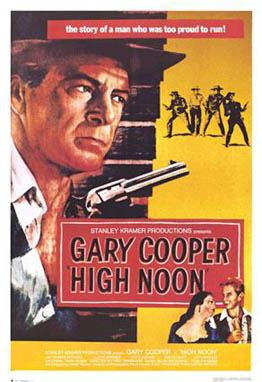
High Noon (1952)


Psalm 90 speaks of God's protection from the "noonday devil" (daemonio meridiano). Who or what is the noonday devil? One possibility is that this devil is not a spirit like Satan and his cohorts, but an evil man or men intent on foul deeds in the full light of sun.

A confrontation between a just man and the noonday devil in the old American West is found in Hollywood's High Noon (1952). There, outgoing Marshall Will Kane (Gary Cooper) -- abandoned by every able-bodied man in town -- is left alone to confront four outlaws, including Frank Miller, a killer just released from prison who has sworn revenge on Kane because Kane was the lawman who saw to it that he was brought to justice.

Even though Kane has made the town safe for their families, the citizens give these evil-doers free rein. Some refuse to back Kane because of cowardice (rationalized by remarkable sophistry), others because of self-interest, and in some instances because of outright malice.

Newly married to pacifist Amy Fowler (Grace Kelly), who threatens to leave if he decides to stay and fight, Kane must decide not only "twixt love and duty" but between conscience and cowardice. As the ballad from the film says,

"The noon day train
will bring Frank Miller.
If I'm a man
I must be brave
and I must face that
deadly killer.

Or lie a coward,
a craven coward,
or lie a coward
in my grave."

Kane knows that if he runs, he will hand over not only the town but also his own soul to the devil in the form of Frank Miller. Helen Ramirez, who has been sequentially the mistress of Frank Miller, Will Kane, and now of Kane's deputy, urges Amy to put her husband before her pacifism. Kane faces his enemies, help comes from an unlikely source, and Frank Miller is slain.

A compelling story of courage versus cowardice, loyalty versus betrayal, resistance versus capitulation to evil, the film is available in DVD format from the usual outlets.

Image:
High Noon poster, from Wikimedia Commons. Copyrighted; fair use claimed.